
Business
Why Is My Car Leaking Fluid? How to Identify Oil, Coolant and Other Leaks

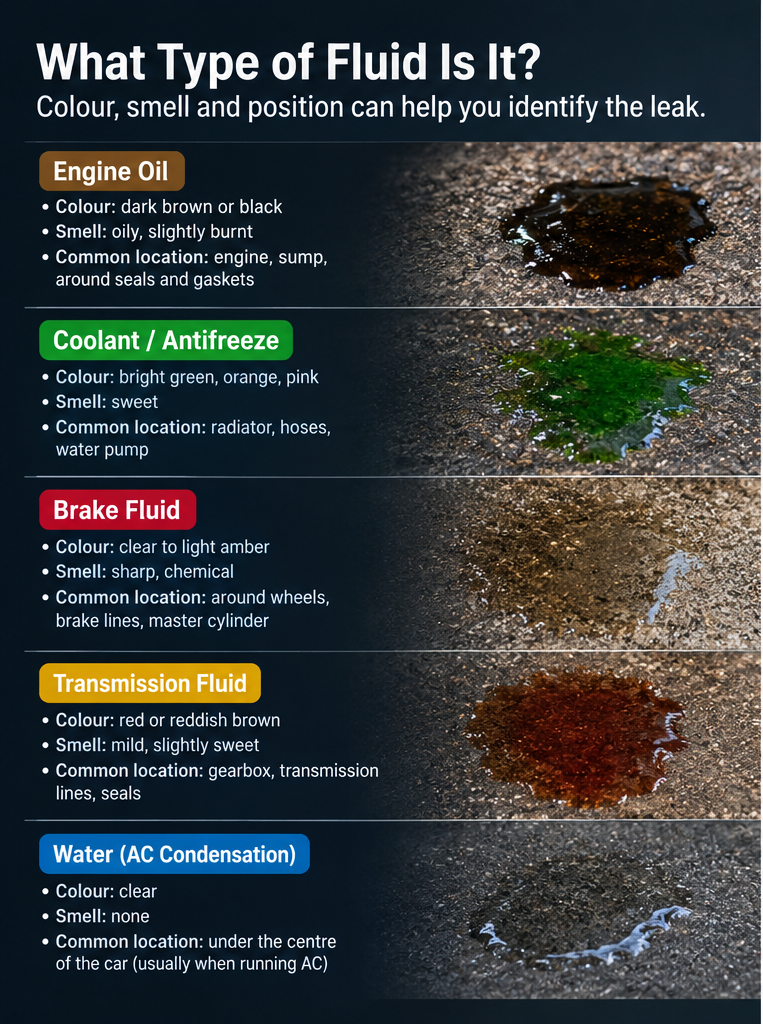
Finding a puddle under your parked car can be worrying. It could be engine oil, coolant, brake fluid or simply water from the air conditioning system. Some leaks are harmless, but others can affect your car’s safety or cause serious damage if you ignore them.
The colour, smell and location of the fluid can help you work out what might be leaking. However, these clues do not always reveal the exact cause. For example, dark fluid could be old engine oil, while coloured liquid near the engine could indicate a coolant leak.
In this guide, we explain how to identify common car fluid leaks, which warning signs to look for, when it may be unsafe to drive and how a technician can find the source of the problem.
The Colour and Feel Test: Identifying a Leak at a Glance
The fastest way to identify a leak is to examine the fluid itself. Place a sheet of white card or kitchen roll under the drip, or dab a small amount from the ground, and look at the colour, feel and smell. Always avoid touching fluids more than necessary and wash your hands afterwards, because many car fluids are harmful.
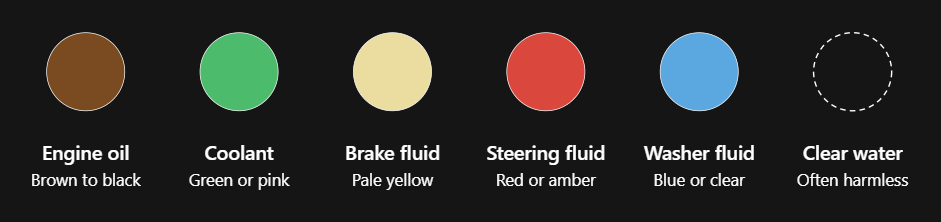
Colour is a strong clue but not a guarantee, because fluids darken with age and mix with dirt and road grime. Used alongside smell, texture and the position of the puddle, it narrows down the culprit quickly.
| Fluid | Typical Colour | Feel | Smell |
| Engine oil | Amber when fresh, dark brown or black when used | Slippery, slightly thick | Burnt or oily |
| Coolant | Green, pink, orange or blue | Thin, slightly slimy | Sweet |
| Brake fluid | Clear to pale yellow or light brown | Slippery, thinner than oil | Faint, slightly fishy or oily |
| Power steering fluid | Red, pink or amber | Thin and oily | Slightly burnt |
| Gearbox fluid | Red or brown | Oily, can be thicker | Strong, sharp |
| Washer fluid | Blue, green or clear | Watery | Soapy or like window cleaner |
| Petrol | Clear to pale yellow | Thin, evaporates fast | Strong and sharp |
| Diesel | Clear to yellow | Slightly oily | Distinctive and heavy |
Car Leaking Oil: The Most Common Fluid Leak
If the fluid is dark brown or black, slippery and smells oily, you almost certainly have a vehicle leaking oil. This is the leak most drivers meet first, and the causes are usually seals and gaskets that harden, shrink and crack with age and heat.
Engine oil is held in by a series of gaskets and seals, and each one is a potential weak point. The valve cover gasket sits on top of the engine and is a very common source, with oil running down the side of the block. The sump gasket or drain plug washer seals the bottom of the engine, and a plug that was not tightened correctly or a washer that was reused can drip slowly. The oil filter can leak if it was not fitted properly or if its seal has deteriorated. Crankshaft and camshaft seals, further inside the engine, can leak onto the belt or the bellhousing, while turbocharged engines have extra oil lines that can weep at their joints.
| Source of Leak | Typical Position | Common Cause |
| Valve cover gasket | Top and side of the engine | Gasket hardens and cracks with heat |
| Sump gasket or drain plug | Underneath the engine | Worn seal or incorrectly tightened plug |
| Oil filter | Side or underneath the engine | Loose filter or perished seal |
| Crankshaft seal | Front or rear of the engine | Seal wear with mileage |
| Oil cooler or turbo lines | Near the engine or turbo | Joints and hoses ageing |
| Damaged sump | Directly below the engine | Impact from road debris or a bump |
Why a Car Leaking Oil When Parked Looks Worse Than It Is
Many drivers notice a car leaking oil when parked more than while driving, and there are two reasons for this. First, hot oil continues to drain down and drip off components for some time after the engine is switched off, so the puddle forms after the car has stopped. Second, some seals only leak when the engine is cold or when it is off, because the seal relaxes without oil pressure holding it in place.
A small spot under the car after a long drive is a warning to investigate, not necessarily an emergency, but it should never be dismissed. Check the dipstick on level ground with the engine cool, and see whether the level is falling. A level that drops between services tells you the leak is real and ongoing.
What a Car Dripping Oil Does to the Engine
When a car is dripping oil, the immediate danger is the falling level. Oil does not get used up in a healthy engine, so any loss is a loss that must be explained. If the level drops far enough, the oil pump begins to draw air, pressure falls and parts that rely on a film of oil start to wear against each other. The red oil pressure warning light is the final alarm, and if it comes on while driving, stop safely as soon as possible and switch off the engine.
There are secondary problems too. Oil that drips onto hot exhaust components can smoke and create a burning smell, and in rare cases it can become a fire risk. Oil on rubber hoses and mounts can soften and perish them, and oil on the drive belt can make it slip.
Oil Leaking Inside the Car: What It Usually Means

Finding a greasy or sticky fluid inside the cabin is alarming, and it is worth being precise about what it might be. Genuine engine oil inside the passenger compartment is unusual, because the engine oil system sits well away from the cabin. More often, an oil leaking inside car report turns out to be one of the following.
| What You Find | Likely Source | Why It Matters |
| Sweet smelling damp carpet, misted windows | Coolant from a leaking heater matrix | Overheating risk, health hazard from fumes |
| Oily or slippery fluid near the pedals | Brake or clutch fluid from the master cylinder | Safety critical, do not drive |
| Oily residue on the boot floor | Rear axle, fuel or spilled containers | Needs inspection |
| Oil smell through the vents | Oil dripping onto hot exhaust, drawn into the air intake | Indicates an active external oil leak |
| Damp patches after rain | Water from a blocked drain or poor seal | Mould and electrical problems |
If the fluid is near the pedals and feels slippery, treat it as a brake or clutch fluid leak until proven otherwise and do not drive the car. If you smell oil through the ventilation, the leak is probably outside the cabin and being drawn in with the air, which still needs to be traced.
Water Dripping Under Your Car: Is It Normal?
Not every puddle is a problem. A clear, odourless puddle is the most common thing drivers find, and often it is harmless. The challenge is knowing the difference between harmless water and a coolant leak that has been diluted or is only just beginning.
Air conditioning is the most frequent cause of water dripping from car underneath. The system removes moisture from the cabin air, and that water drains out through a small tube, usually near the front on the passenger side. On a warm day, a steady drip of clear water after using the air conditioning is exactly what should happen. Exhaust condensation is another normal source, because the exhaust gases contain water vapour that condenses inside the pipe, especially after short cold journeys, and drips from the tailpipe.
Water dripping under the car that behaves differently deserves a closer look. If the liquid is coloured, sweet smelling, slippery or continues when the air conditioning has been off for hours, it may be coolant. A car that leaks water underneath after rain could also have blocked sunroof or scuttle drains, sending water down the wrong path.

| Water Related Drip | Where You See It | Normal or Not |
| Air conditioning condensation | Front, usually passenger side, after using the air conditioning | Normal |
| Exhaust condensation | Tailpipe, especially on cold starts and short trips | Normal |
| Washer fluid leak | Near the front wheel arch or washer bottle | Not normal, needs repair |
| Coolant leak | Front of the engine, radiator area, near hoses | Not normal, urgent |
| Blocked drain overflow | Sills, footwells or under the doors after rain | Not normal, needs attention |
| Windscreen or door seal leak | Inside the cabin after rain | Not normal, causes damp and corrosion |
Where Is the Leak? Reading the Position of the Puddle
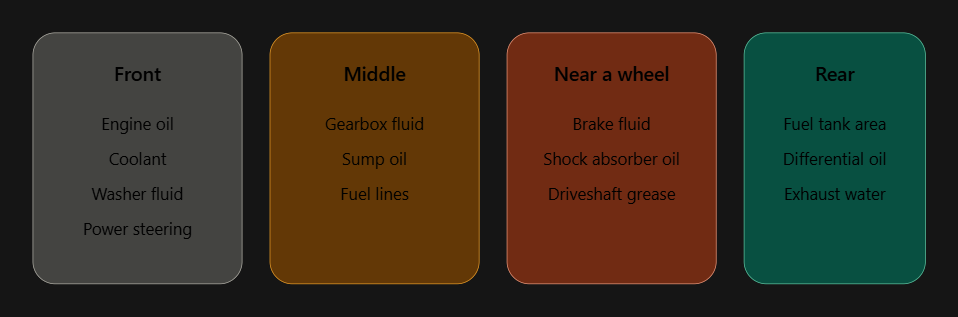
The location of the puddle is one of the most useful clues you have. Fluids tend to drip close to where they leak, although airflow and the slope of the ground can carry them some distance.

| Stage | What Is Happening | What the Driver Notices |
| Early | A gasket or seal begins to harden or crack | A faint damp patch, a slight smell of hot oil |
| Developing | The gap widens and oil escapes more freely | Spots on the drive, a slowly falling dipstick level |
| Advanced | Oil level drops noticeably, parts run with less protection | Smoke from the engine bay, low oil warning |
| Severe | The engine runs short of oil and wear accelerates | Knocking, loss of power, oil pressure light, possible engine failure |
A vehicle leaking oil at the early stage is usually a straightforward repair involving a single gasket or seal. The same leak left for months can contaminate belts and hoses, coat the engine in grime that hides other faults and, in the worst case, end in engine damage that is far more disruptive than the original problem.
The Safe Home Check: A Simple Way to Identify a Leak
You do not need tools to gather useful information. A few minutes of careful checking gives a technician a head start and helps you decide how urgent the situation is.
- Park on level ground and place a large sheet of clean cardboard or white paper under the engine area overnight
- Check the colour, texture and smell of any drops, and note exactly where they landed
- Photograph the cardboard in good light, because the pattern is useful evidence
- With the engine cold and the car level, check the oil dipstick, coolant expansion tank and brake fluid reservoir against their minimum and maximum marks
- Look under the bonnet for wet, shiny or grimy areas, but do not touch anything hot or open the coolant cap while the engine is warm
- Check the dashboard for oil pressure, coolant temperature or brake warning lights
- Note when the leak happens, such as only after parking, only when driving, or only when the air conditioning is on
Do not wash the engine bay before the check if you can avoid it, because a clean engine with fresh drips is easier to diagnose than one that has just been pressure washed, and never wash spilled fluid into a drain. Small spills on a driveway can be soaked up with absorbent material and disposed of through your local council waste facility.
Should You Keep Driving With a Leak?
The honest answer depends on the fluid and the amount. A short, careful journey may be reasonable in some cases, but several situations mean the car should not be driven at all.
| Situation | Advice |
| Brake pedal feels soft or fluid is near the wheels or pedals | Do not drive, arrange recovery |
| Strong smell of fuel or visible fuel dripping | Do not drive, keep away from ignition sources |
| Red oil pressure warning light on | Stop safely and switch off the engine |
| Temperature gauge rising or coolant warning light | Stop safely, allow to cool, do not open the cap hot |
| Oil level near or below the minimum mark | Top up with the correct oil and arrange an inspection before further driving |
| Small oil drips but level is stable | Drive carefully, check the level often, book a repair soon |
| Clear water after using air conditioning | Normal, no action needed |
If you do need to top up a fluid to get to a garage, use the correct specification for your vehicle, because the wrong oil or coolant can cause its own problems. The handbook or the filler cap markings will tell you what is needed.
How a Technician Finds the Source of a Leak
Finding where a fluid comes from is often harder than it sounds, because fluid runs, drips and gets blown around by airflow. A methodical diagnosis avoids replacing the wrong part.
The car is raised and the area is inspected from above and below. The suspect area is cleaned thoroughly so that fresh fluid is easy to spot, and the engine is run while the technician looks for the original point of escape. For stubborn leaks, a UV dye can be added to the fluid, and a special lamp then shows exactly where it emerges. Cooling systems can be pressure tested to reveal leaks that only appear under pressure, and brake systems are checked for pipe corrosion, hose damage and caliper or master cylinder leaks.
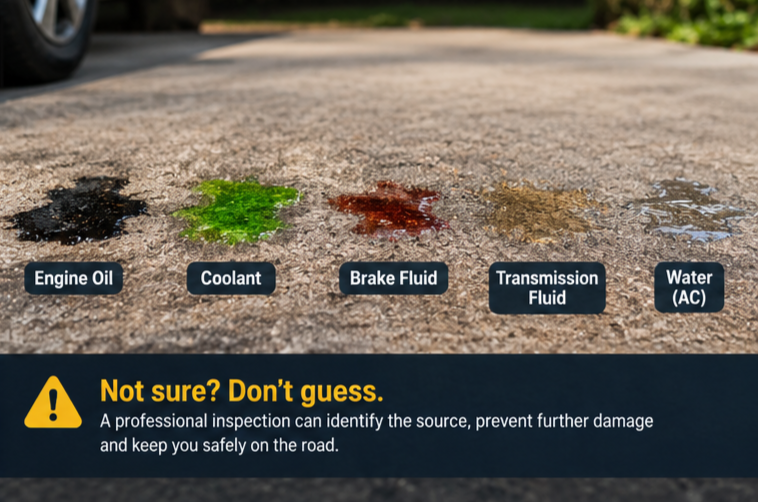
The goal is to identify the actual cause rather than the most visible symptom. An oil patch near the sump might come from a leaking valve cover higher up, and replacing the sump gasket would not stop it. Clear, evidence based diagnosis saves time and prevents repeat repairs.
Because fluid leaks can come from several different components, professional inspection and car repairs in Aldershot can help identify the source and prevent the fault from getting worse.
How Fluid Leaks Affect Your MOT
Leaks are taken seriously at an MOT test because they can affect safety, the environment and the reliability of the vehicle. A brake fluid leak or a fuel leak is a significant safety concern and can result in an immediate failure. A leak that is dripping or presents an environmental or fire risk can also be recorded as a defect that needs repair, while a light seep may be noted as a lower level issue.
Fluid Leaks and Your Vehicle Warranty
A common worry is that having a leak repaired, or the car serviced, away from a main dealer will affect a manufacturer warranty. In general, a car can be serviced and repaired at an independent garage without invalidating a warranty, provided the work follows the manufacturer’s schedule, uses parts of the correct specification and is properly recorded. The details depend on the terms of your own warranty, so it is sensible to read them, but good record keeping is the most important protection.
The practical point for leak repairs is that a clear invoice showing the fault, the parts fitted and the fluid specification used is valuable evidence, both for the warranty and for the vehicle’s service history.
How Regular Servicing Helps Prevent Leaks
Many leaks develop slowly, and a service is the best opportunity to catch them early. During a service, a technician checks fluid levels, inspects hoses, pipes and seals for dampness, looks underneath for signs of weeping and replaces oil and filters with new seals. Old oil and tired filters can put extra strain on seals, so changing them on schedule helps protect the gaskets that hold the oil in.
Fluids themselves also age. Brake fluid absorbs moisture over time and can corrode the system from the inside, and coolant loses its protective additives, which can lead to internal corrosion and eventually to leaks from the radiator, pump or heater matrix. Replacing these fluids at the recommended intervals protects the components that hold them.
Regular inspections can help identify leaking hoses, worn seals and fluid loss before they lead to more serious problems. Ash Road Service Centre can help drivers assess vehicle problems and understand the repairs needed.
| Service Check | What It Can Reveal | Leak Prevented or Caught |
| Oil and filter change | Fresh oil and new seals | Filter and drain plug leaks |
| Underbonnet inspection | Damp or grimy gaskets and hoses | Early valve cover and hose leaks |
| Underside inspection | Wet sump, gearbox or driveshaft seals | Slow weeps before they become drips |
| Brake fluid test | Moisture content and condition | Corrosion that leads to brake leaks |
| Coolant test | Strength and condition | Corrosion in the cooling system |
| Hose and pipe check | Perished or swollen rubber | Coolant and power steering leaks |
Common Myths About Car Leaks
| Myth | The More Accurate Picture |
| A small oil leak is nothing to worry about | Small leaks grow, and the falling oil level can damage the engine |
| Thicker oil will stop a leak | It may slow a leak briefly, but it does not repair a failed seal and can cause other problems |
| Leak stop additives are a permanent fix | They are at best a temporary measure and can affect seals and passages |
| All water under the car is harmless | Clear water is often harmless, but coloured or sweet smelling liquid may be coolant |
| If the warning light is off, the level is fine | Warning lights often come on only when the situation is already serious |
| Leaks only matter if they leave a puddle | Many leaks evaporate or burn off on hot parts and leave no puddle |
| Topping up is the same as repairing | Topping up replaces the fluid, but the leak continues |
Conclusion
A car leaking fluid is trying to tell you something, and learning to read the message is one of the most valuable habits a driver can build. The colour tells you where to start, the smell and feel narrow the options, and the position of the puddle points towards the likely source. A dark, slippery patch means a car leaking oil, a bright and sweet smelling liquid suggests coolant, a pale slippery fluid near the wheels or pedals points to the brakes, and clear, odourless water after using the air conditioning is usually nothing to worry about at all.
What matters most is how different leaks deserve different responses. Some, such as brake fluid and fuel, mean the car should not be driven. Others, such as engine oil and coolant, may allow a careful trip to a garage but become dangerous if the level falls too far, and a few, such as condensation and washer fluid, are low risk. The mistake is treating all of them the same, either panicking over harmless water or ignoring a slow oil leak because the car still seems to run perfectly.
The practical approach is simple. Note the colour, smell and position, check the fluid levels, watch for warning lights and avoid pushing on if anything feels wrong. Arrange a proper inspection rather than relying on top ups, because the aim is to stop the leak, not hide it. Combined with regular servicing, which catches weeping seals and ageing hoses early, and with a check before each MOT, this approach keeps small leaks small, protects the engine and the other systems that rely on those fluids, and gives you confidence that the next patch on the drive will be nothing more than a harmless puddle of water.
If you need help with a suspected fluid leak, you can read Ash Road Service Centre reviews on Google before contacting the garage about an inspection.
Frequently Asked Questions
Why is my car leaking oil when parked?
Hot oil continues to drain off components after the engine stops, and some seals relax and leak once oil pressure disappears. A car leaking oil when parked usually has a failing gasket or seal, and the level should be checked and the source traced.
Is it safe to drive a vehicle leaking oil?
It depends on how fast the level is falling. A small drip with a stable level may allow careful driving to a garage, but if the level is low or the oil pressure light comes on, stop and avoid driving further.
Why is there oil leaking inside my car?
True engine oil inside the cabin is unusual. A greasy or damp patch inside is more often coolant from a heater matrix, brake or clutch fluid near the pedals, or an external oil leak whose smell is drawn in through the vents.
Is water dripping under my car normal?
Often yes. Clear, odourless water from the front passenger side after using the air conditioning, or from the tailpipe on a cold start, is normal. Coloured, sweet smelling or slippery liquid is not.
Why does my car leak water underneath after rain?
Blocked sunroof or scuttle drains, or worn door and windscreen seals, can send rainwater into places it should not go. This can lead to damp carpets, mould and electrical faults, so it should be checked.
What colour is a coolant leak?
Coolant is commonly green, pink, orange or blue, with a sweet smell. It is thinner than oil and slightly slimy to the touch.
Can a leak cause an MOT failure?
Yes. Brake fluid and fuel leaks can cause a failure, and an oil or other fluid leak that is dripping or poses an environmental or fire risk can also be recorded as a defect. Light seepage is often an advisory.
Will repairing a leak at an independent garage affect my warranty?
Generally not, provided the work follows the manufacturer’s requirements, uses correct parts and fluids and is properly documented. Check the terms of your own warranty if you are unsure.


Three months into working with an AI SEO agency, most business owners reach the same question. The monthly report arrives with a few screenshots of ChatGPT naming the business, a chart that goes up and a list of tasks completed. It looks like progress. But is it?
AI search makes that harder to judge than Google rankings ever were. There is no position three to point at, and the same question asked twice can produce two different answers. That does not mean the work cannot be measured. It means you need to know what sound measurement looks like, so you can tell real progress from a lucky screenshot.
Why a single screenshot proves very little
In January 2026, SparkToro and Gumshoe.ai published research in which 600 volunteers ran the same 12 prompts through ChatGPT, Claude and Google’s AI almost 3,000 times. They found less than a 1 in 100 chance that ChatGPT or Google’s AI would return the same list of brands twice. The order of those lists was even less stable.
In practice, a screenshot showing your business named first may be luck. So may a screenshot where you are missing. Neither tells you much on its own.
The study also pointed to something more useful. List position jumps about from run to run, but the share of runs in which a brand appears at all, across many repeats of the same questions, is a reasonable thing to measure. That figure, often called a visibility rate, is what a good report should be built on.
What a useful AI SEO agency report should show
Whether you work with a specialist AI SEO agency or run the checks in-house, a report worth paying for covers seven things.
- A fixed set of real customer questions. They should be agreed at the start and kept stable, so month-on-month comparisons mean something. Good questions come from sales calls, enquiry forms and search data. Questions such as ‘what is [your company]?’ are easy wins and tell you nothing about whether a stranger would find you.
- Repeat runs, reported as a rate. ‘Named in 14 of 20 runs’ is a measurement. ‘You appeared in ChatGPT’ is an anecdote.
- Results for each platform. ChatGPT, Gemini, Perplexity, Microsoft Copilot and Google’s AI Overviews and AI Mode each find and weigh sources differently. A single blended score can hide the fact that you are strong in one and absent from another.
- Mentions, recommendations and citations kept apart. Being listed in passing, being recommended outright and having your page linked as a source are three different outcomes. The report should say which one happened.
- Accuracy checks. If an assistant quotes the wrong prices, an old address or a service you no longer offer, that is a problem to fix, not a mention to celebrate.
- The sources behind the answers. Which websites did the AI rely on when it named you, or when it named a competitor instead? That list shows where the next round of work should go.
- Competitors on the same questions. Your visibility rate only means something next to the businesses you are actually up against.
Data you can check without the agency
Most AI visibility figures come from an agency’s own tracking tool, so it helps to have a few numbers you can see for yourself.
Since February 2026, Bing Webmaster Tools has included an AI Performance report, currently in public preview. It shows how often pages on your site are cited as sources in Microsoft Copilot and in AI-generated summaries in Bing, which pages are cited and a sample of the queries behind those citations. It does not show clicks and only covers Microsoft’s products, but it is free, first-party data and takes minutes to set up.
Two simpler checks are worth adding. Your analytics will show visits referred from AI tools such as ChatGPT and Perplexity, although many people read the answer and never click through. Your enquiry form can also ask how people found you, with an AI assistant listed as an option. Neither is perfect, but together they show whether visibility is turning into real conversations.
Warning signs in an agency report
- Rankings in AI answers. A claim that you are ‘number one in ChatGPT’ describes a single run, not a stable position.
- Only branded questions. If every tracked prompt includes your company name, the report measures whether AI knows you exist, not whether it recommends you.
- No baseline. Without a record from before the work started, nobody can say what changed.
- Undated screenshots with no run count. These are illustrations, not data.
- Claims of special access. No agency can buy or arrange a place in the unpaid answers of ChatGPT, Gemini or Copilot. Anyone who suggests otherwise is overselling.
- Activity without outcomes. ‘Four articles published’ only matters if you can see which questions those articles were meant to win.
Connecting the numbers to the work
The best reports read as cause and effect. A rise in visibility on pricing questions should line up with something that was done, such as a clear fees page or a corrected listing on a site the AI was already citing. A fall should come with an explanation and a plan.
Take a hypothetical accountancy practice in Bristol tracking 25 customer questions, each run ten times a month across four platforms. In the baseline month it appears in 9 per cent of runs, mostly for questions that include its own name. Over the next quarter the agency fixes inconsistent details across directories, publishes plain answers to common questions about fees and deadlines, and earns a mention in a local business roundup that Perplexity was already citing. By month four the practice appears in 27 per cent of runs, and Bing Webmaster Tools shows its new fees page being cited in Copilot. Every number in that report has a reason attached, which is what makes it useful.
Questions to ask at your next review
If you are not sure the work is paying off, take these to your next meeting:
- Which questions improved this month, which got worse, and why?
- How many times was each question run, and on which dates?
- Which sources did the AI cite this month that it did not cite last month?
- What will you change next month because of these results?
A good AI SEO agency will be glad to answer, because the answers are the evidence for its work. If the replies are vague, or the report falls apart under a few simple questions, that tells you more than any screenshot.


Introduction
Superfoods have earned their reputation for being rich in nutrients, antioxidants, vitamins, and minerals that can support overall wellness. While many people understand the benefits of incorporating nutrient-dense foods into their diets, finding practical and enjoyable ways to consume them consistently can be a challenge. Busy schedules, limited meal-prep time, and repetitive eating habits often make it difficult to maintain healthy routines.
Fortunately, adding more superfoods to your lifestyle does not require a complete dietary overhaul. Small, creative adjustments can make nutritious choices easier, more enjoyable, and sustainable over the long term. Here are seven effective ways to incorporate more superfoods into your daily routine without feeling overwhelmed.
Start Your Morning with a Nutrient-Packed Smoothie
One of the simplest ways to increase superfood intake is by beginning the day with a smoothie. Smoothies offer an easy opportunity to combine multiple nutrient-rich ingredients into a single meal or snack.
Try blending leafy greens such as spinach or kale with berries, bananas, chia seeds, and unsweetened yogurt. This combination provides fiber, antioxidants, vitamins, and protein while creating a delicious and satisfying drink.
The flexibility of smoothies allows you to experiment with seasonal ingredients and personalize flavors while consistently boosting your daily nutrient intake.
Upgrade Your Breakfast Toppings
Breakfast often serves as the foundation for healthy eating habits throughout the day. Instead of relying solely on traditional toppings, consider incorporating superfoods into common breakfast dishes.
Oatmeal, yogurt, and whole-grain toast can be enhanced with nutrient-rich ingredients such as berries, flaxseeds, pumpkin seeds, walnuts, or sliced fruit. These additions improve both nutritional value and flavor while providing sustained energy for the morning ahead.
Making small improvements to meals you already enjoy is an effective strategy for maintaining long-term healthy habits.
Keep Convenient Superfood Snacks Available
Many unhealthy food choices occur simply because nutritious options are not easily accessible. Preparing convenient superfood snacks in advance can help reduce reliance on processed foods.
Nuts, dried berries, roasted chickpeas, and homemade trail mixes are excellent choices for busy individuals. Keeping these snacks in your bag, desk drawer, or vehicle ensures healthier options are always within reach.
Having nutrient-dense foods readily available can make it easier to maintain wellness goals even during hectic days.
Add Greens and Algae-Based Nutrition to Daily Habits
Some individuals look beyond fruits and vegetables to diversify their nutritional intake. Algae-derived foods and supplements have become increasingly popular due to their concentrated nutrient content.
For example, incorporating daily routine chlorella tablets into an existing wellness plan can offer a convenient way to complement a balanced diet. When combined with whole foods and healthy lifestyle habits, these nutritional additions can help support consistent wellness goals without requiring major changes to daily schedules.
The key is integrating them naturally into routines that are already established and easy to maintain.
Enhance Salads with Superfood Ingredients
Salads provide an excellent foundation for creative superfood combinations. Rather than limiting salads to lettuce and a few vegetables, consider adding nutrient-dense ingredients that increase both flavor and nutritional diversity.
Options such as quinoa, avocado, sunflower seeds, blueberries, pomegranate seeds, and walnuts can transform a simple salad into a satisfying meal. These additions contribute healthy fats, fiber, antioxidants, and essential nutrients.
Rotating ingredients regularly can also help prevent meal fatigue while exposing the body to a broader spectrum of beneficial nutrients.
Incorporate Superfoods into Homemade Cooking
Many superfoods can be seamlessly integrated into everyday recipes. Soups, stir-fries, baked goods, and pasta dishes all provide opportunities for adding nutrient-rich ingredients.
For example, vegetables such as spinach and broccoli can be mixed into sauces and casseroles, while chia seeds and flaxseeds can be added to muffins, pancakes, or smoothies. Herbs and spices like turmeric and ginger can also enhance both flavor and nutritional value.
These simple culinary adjustments allow individuals to increase superfood intake without dramatically changing their favorite meals.
Create a Consistent Weekly Meal Planning Strategy
Consistency is often the difference between short-term dietary improvements and lasting lifestyle changes. Planning meals ahead of time helps ensure superfoods remain a regular part of the diet rather than an occasional addition.
Consider selecting a few superfoods each week and intentionally incorporating them into breakfasts, lunches, dinners, and snacks. Keeping a shopping list focused on nutrient-dense foods can improve purchasing decisions and reduce impulse buys.
Meal planning also minimizes stress during busy weeks, making it easier to prioritize nutrition even when time is limited.
Conclusion
Adding more superfoods to your daily routine does not have to be complicated. Small, intentional habits such as improving breakfast choices, preparing nutritious snacks, enhancing salads, using nutrient-rich ingredients in home cooking, and planning meals in advance can make a significant difference over time.
The most effective approach is one that fits naturally into your lifestyle and can be maintained consistently. By making gradual changes and embracing creative ways to incorporate superfoods into everyday meals, you can build a sustainable foundation for long-term health and wellness.


Can a draughty Victorian terrace or a 1930s semi in Bristol run on a heat pump without a full heating overhaul? Often it can, but the answer sits in details that a first quote either covers or skips. Anyone comparing air source heat pump installation in Bristol options will get far more from the quotes by knowing what to look for before the surveyor arrives.
Bristol’s housing is a patchwork. Tall Victorian terraces sit beside solid-walled Edwardian semis, interwar estates and newer flats, and each reacts in its own way once the gas boiler goes.
That variety is why generic advice falls flat. Two houses on the same street can call for different radiators, a bigger or smaller cylinder and another spot for the outdoor unit.
Which Bristol homes suit a heat pump
A heat pump works best at lower water temperatures than a gas boiler, so the real question is how much heat a house loses and how large its radiators are. That’s why a proper air source heat pump Bristol survey starts with the building rather than the machine. A 1930s semi with filled cavity walls and a well-insulated loft is a very different case from a solid-walled terrace with original sash windows.
Older houses aren’t ruled out. They often need a few extras, such as more loft insulation, several larger radiators or a new hot water cylinder, and those extras should appear as line items rather than surprises. Draught-proofing sash windows and sealing gaps under floorboards costs little and cuts the load before any equipment is sized.
A competent surveyor should look at these points before anyone mentions a model:
- Room-by-room heat loss figures, because the unit’s output should match what the house actually loses on a cold night.
- The size and condition of existing radiators, since undersized ones are the usual reason a heat pump feels weak in an old house.
- Loft and wall insulation, since good levels may let a smaller and cheaper unit do the job.
- Hot water demand and cylinder space, so a family of five doesn’t end up with a tank sized for two.
Siting matters too. The outdoor unit needs room and free airflow, and the noise at the nearest bedroom window or neighbour’s boundary should be weighed first. In tight terraced streets, that single decision can shape the whole layout.
What an air source heat pump service involves after installation
Heat pumps are low-maintenance, not no-maintenance. A yearly air source heat pump service keeps the system efficient and catches small faults before the first cold snap does it for you.
The visit usually covers the outdoor unit, where leaves, debris and the odd frost problem build up, along with electrical connections, the condition of the heating water and the control settings. Many owners never touch those settings after the first week. That’s often where efficiency quietly slips, so a fresh pair of eyes on the schedule and flow temperature is worth having.
Ask early who will carry out servicing and whether it’s the firm that fitted the unit. If that company disappears within a couple of years, you’re left hunting for someone willing to work on a system they didn’t install. Manufacturer warranties can also depend on service records, so keep every report.
Between visits, the job is simple. Keep shrubs, snow and stacked bin bags away from the outdoor unit, and glance at the pressure gauge on the heating circuit if there’s one.
Air source heat pump engineer Bristol prices and how to read a quote

One headline number says very little. Anyone collecting air source heat pump engineer Bristol prices will notice a wide spread, and most of it comes from what each proposal quietly includes or leaves out. Two proposals for the same house can look thousands of pounds apart simply because one omits the cylinder, the radiators or the commissioning.
A fixed price given after a proper visit is more trustworthy than a figure offered over the phone. A phone price is a guess about a house nobody has seen, and guesses tend to be corrected upward later. A good written quote lists separately:
- The heat pump unit and its output, with the heat loss figure used to choose it, so you can see the sizing wasn’t guesswork.
- The hot water cylinder and any pipework changes, which are common in older houses and easy to bury in a headline price.
- Radiator upgrades and controls, listed room by room, so you know what’s being replaced and what stays.
- Commissioning, handover and warranty terms, which show whether the firm stands behind the system once it’s running.
The Boiler Upgrade Scheme can reduce the cost for eligible homes in England and Wales, and the discount is applied through the installer. Check that it appears as a separate deduction, not as a vague saving folded into the total. If the price assumes a grant, confirm your eligibility on the government’s website before accepting it.
Heat pump installers and the checks that separate good from poor
Picking between heat pump installers comes down to evidence. Plenty of firms promise comfort and low bills, but fewer can show how they reached their numbers for your particular house.
On an air source heat pump Bristol job, MCS certification is the first box to tick. Without it, neither the installer nor the equipment qualifies for the Boiler Upgrade Scheme, so the grant simply disappears. Ask for the certificate number and check it against the MCS register rather than relying on a logo in an email.
Before you sign, ask each firm for a site visit with measurements and a heat loss calculation, not a figure built from a postcode and a property type. Request a written design showing the unit’s location, pipe routes and cylinder position, so nothing is improvised on the day. Examples of earlier installs in similar houses are worth asking for too, ideally with an owner who’s happy to answer questions. A Victorian terrace and a 1930s semi pose distinct problems, so a gallery of new builds proves very little. Finally, get clear aftercare terms covering workmanship guarantees, servicing and who to call when something stops working.
Then lay the quotes side by side using the line items above. The firm whose numbers you can follow, line by line, is usually the one that did the homework. Be wary of any discount that expires this week, because a sound design doesn’t go stale in seven days.
To make the visits productive, gather your latest energy bills, your EPC if you have one, and a few photos of your radiators, loft and the wall where the outdoor unit might sit. Surveyors can then spend their time measuring rather than asking basic questions, and you’ll see quickly how thorough each one really is.

6 Benefits of Personalized Lifestyle Planning

How to Tell Whether Your AI SEO Agency Is Actually Working

7 Creative Ways to Add More Superfoods to Your Daily Routine

Who Is Rita Johal? All About Riyad Mahrez’s Former Wife and Her Story

Who Is Caroline Hickman? Story of Caroline Hickman, Steve Coogan’s Ex Wife

Who is Sarah Vincent? All About Vic Reeves’ Ex Wife and Their Children
-
 Celebrity5 months ago
Who Is Rita Johal? All About Riyad Mahrez’s Former Wife and Her Story
-
 Celebrity5 months ago
Who Is Caroline Hickman? Story of Caroline Hickman, Steve Coogan’s Ex Wife
-
 Celebrity5 months ago
Who is Sarah Vincent? All About Vic Reeves’ Ex Wife and Their Children
-
 Celebrity5 months ago
The Life of Giselle Glasman: Actress, Theatre Publicist, and Lennie James’ Wife
-

 Celebrity4 months ago
Who Was Carolyn Cox? Biography of Nigel Havers’ Ex Wife
-

 Celebrity5 months ago
Who is Eleasha Hamed? Boxing Legend Naseem Hamed’s Wife
-

 Celebrity5 months ago
Who Is Annie Milner? Untold Story of Paul McGann’s Former Wife
-

 Celebrity5 months ago
Story of Merula Salaman and Her Life with Alec Guinness