
Business
Why Does My Car Make a Humming Noise at High Speeds?


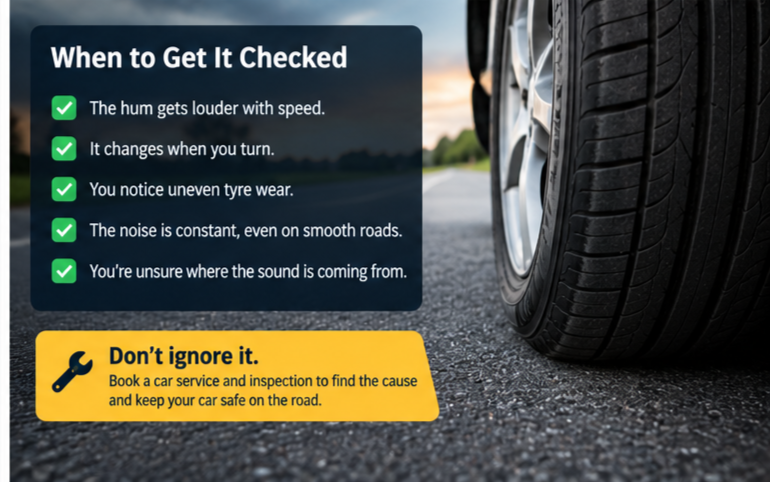
A humming noise at high speeds can point to worn tyres, a damaged wheel bearing or a problem with the drivetrain. The sound may start quietly, become louder as you accelerate, or change when you drive over different road surfaces.
It can be tempting to ignore the noise if your car still feels normal. However, a new or worsening hum should not be overlooked. Some causes are relatively simple to fix, while others can affect the safety and reliability of your vehicle.
In this guide, we explain the possible causes of a humming noise at high speeds, the warning signs to watch for, and how a garage can investigate the problem. We also cover when to arrange an inspection and when it may be unsafe to continue driving.
What a High Speed Hum Actually Is
A hum is a continuous, low pitched tone. It is different from a knock, which is a repeated impact, and different from a squeal, which is a sharp high pitched sound. Continuous tones are produced by rotating parts, and the pitch rises with the speed of rotation. That single fact is the key to diagnosis.
Different components rotate at different speeds relative to the car. The wheels, tyres, wheel bearings and driveshafts turn in proportion to road speed. The engine, alternator, water pump and power steering pump turn in proportion to engine speed. The gearbox sits between the two, which is why gear selection changes some noises and leaves others untouched.
So the first question is never “what is the noise?” It is “what does the noise follow?” If it follows road speed, the cause is at the wheels or in the driveline. If it follows engine speed, the cause is under the bonnet or in the gearbox. If it follows something else entirely, such as steering input or road surface, that points to a third group of causes.
Step One: Work Out What Changes the Noise
Before looking at individual causes, it helps to see how the main behaviours map to likely sources. The four clues below narrow the field faster than any other test.
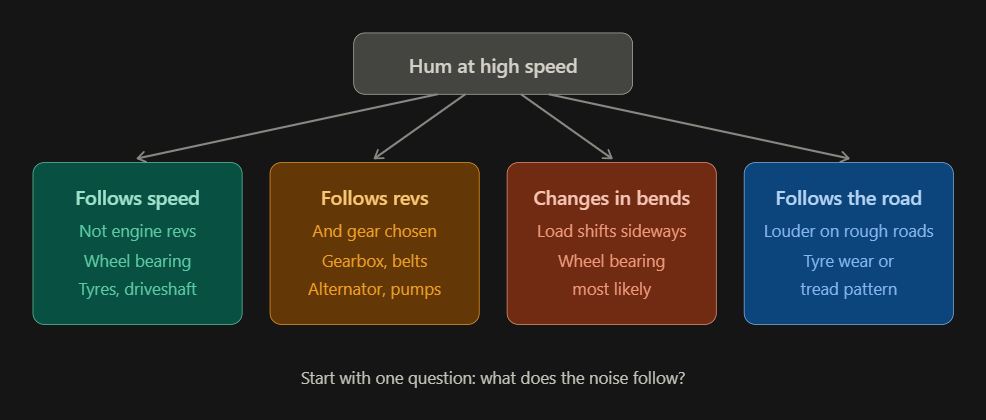
| What the noise does | Most likely area | First thing to check |
| Rises with road speed, stays when you lift off the accelerator | Wheels, tyres, bearings, driveshaft | Tyre wear pattern and wheel play |
| Rises with engine revs and changes between gears | Gearbox, alternator, pumps, belts | Fluid levels and belt condition |
| Louder or quieter when you steer one way | Wheel bearing | Which side gets louder, then inspect that hub |
| Louder on coarse tarmac, quieter on smooth | Tyres | Tread depth and wear shape |
| Appears only when turning the steering wheel | Power steering | Fluid level and pump condition |
| Low throb with a window or sunroof open | Wind buffeting | Close the window and listen again |
Cause One: A Worn Wheel Bearing
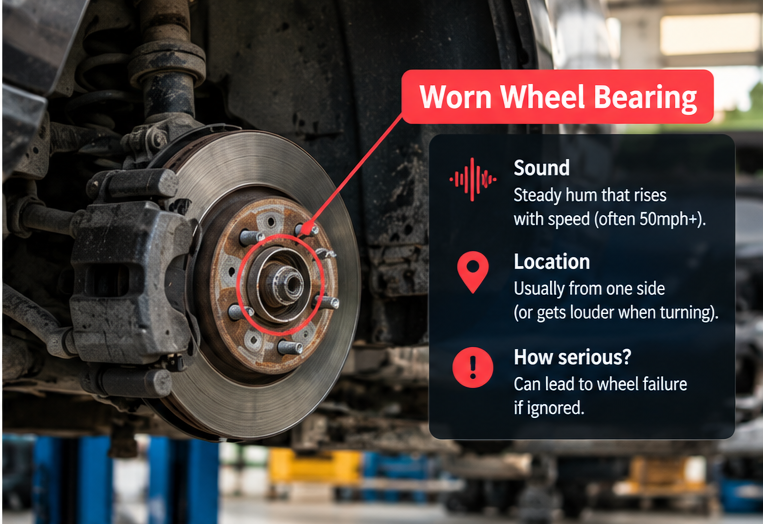
A failing wheel bearing is the most common cause of a hum that rises with road speed, and it is the one most worth taking seriously.
Each wheel turns on a bearing, a sealed set of steel balls or rollers running between hardened tracks and packed with grease. It carries the weight of the car at that corner and allows the wheel to spin with almost no friction. On most modern cars it is a sealed hub unit that is replaced as a single part.
Bearings fail for a handful of reasons. Water and grit get past a worn seal and wash out the grease. A pothole or kerb strike dents the bearing tracks. Years of load simply wear the surfaces. Once the tracks are even slightly damaged, the rolling balls make a continuous roughness that you hear as a hum, then a growl, then a grind.
On the rural lanes around Ash and Tongham, where potholes and broken edges are common, impact damage is a frequent trigger. A bearing that survives one hard hit can start humming weeks later.
How a Wheel Bearing Hum Behaves
A bearing hum has some very recognisable habits:
- It rises smoothly with road speed and falls as you slow down.
- It does not change when you press or release the accelerator.
- It often changes when you steer, because cornering shifts weight onto the outside wheels.
- It can produce a faint vibration through the floor or steering wheel as it worsens.
The cornering clue is the most useful. When you turn left, the car’s weight moves to the right side, loading the right hand wheel bearings. If the hum gets louder on a left bend, the right hand bearing is the likely culprit. If it gets louder on a right bend, suspect the left. Some drivers also find the noise quietens slightly as the failing bearing is unloaded.
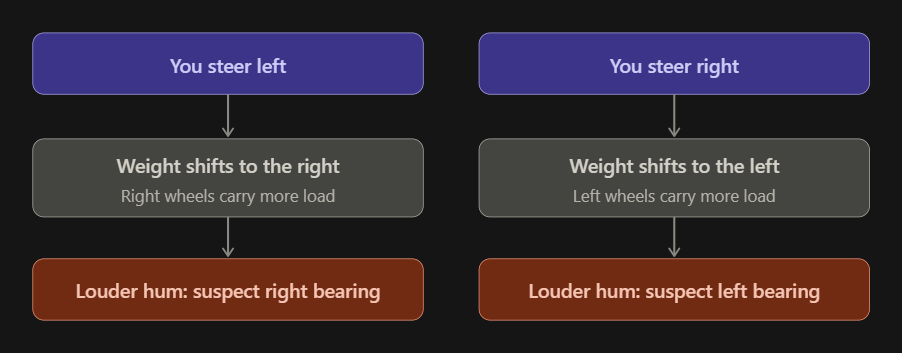
This is a guide rather than a guarantee. A garage will confirm the exact wheel by lifting the car and checking each hub for play and roughness. But it narrows the search sensibly before you book.
How Serious Is a Wheel Bearing Hum?
| Stage | What you notice | What to do |
| Early | Faint hum above 50 mph, no vibration | Book an inspection within a week or two |
| Developing | Clear hum or growl, louder in bends | Book inspection promptly, limit speed and distance |
| Advanced | Grinding, vibration, play in the wheel, ABS warning light | Stop driving and arrange recovery or repair |
A bearing that is allowed to deteriorate fully can overheat, seize or develop enough play to affect steering and braking. That is rare, but it is the reason a persistent hum should be inspected rather than monitored indefinitely.
Cause Two: Uneven Tyre Wear and Tyre Noise
Tyres are the second most common source of a high speed hum, and they are the easiest cause to check yourself.
A tyre with a worn or uneven tread pattern produces a rhythmic noise as the tread blocks strike the road. When the wear is regular, such as a scalloped or cupped pattern around the circumference, the noise becomes a continuous hum that rises with speed. It can sound almost identical to a bearing, which is why tyres should always be ruled in or out before a bearing is condemned.
Common Wear Patterns and What Causes Them
| Wear pattern | What it looks like | Likely cause |
| Cupping or scalloping | Dips and scoops around the tread | Worn shock absorbers or damper issues |
| Feathering | Tread blocks smooth one side, sharp on the other | Misaligned toe settings |
| Inner or outer edge wear | One shoulder worn much faster | Alignment or camber problems |
| Centre wear | Middle of the tread worn | Over inflation |
| Both edges worn | Shoulders worn, centre fine | Under inflation |
Run your hand slowly across the tread of each tyre. Feathering and cupping can often be felt as a rough, stepped surface even before they are obvious to the eye.
Telling Tyre Noise From Bearing Noise
Tyre noise tends to change with the road surface. It is louder on coarse tarmac and quieter on smooth, newly laid roads. A bearing hum stays much the same regardless of surface. Tyre noise can also move or change character if the tyres are rotated front to back, which is a simple and inexpensive way to test the theory.
Around Aldershot, where roads vary from smooth main routes to older patched surfaces, drivers often notice the hum come and go with the road. That is a strong hint towards the tyres rather than the bearings.
Tyre type matters too. Some tread patterns, such as aggressive all terrain or winter designs, are simply louder at speed than a standard road tyre. That is normal and is not a fault, provided the hum is consistent from new.
Check the Legal Basics While You Are There
While inspecting the tyres, check tread depth across the full width. The legal minimum is 1.6mm, and most professionals recommend replacing before 3mm. A tyre that is both noisy and close to the limit should be replaced rather than simply rotated.
Cause Three: Wheel Balance and Alignment
A wheel that is out of balance usually produces a vibration rather than a pure hum, but the two are easy to confuse. The vibration typically appears in a specific speed band, often between 55 and 70 mph, and fades above or below it. You feel it in the steering wheel if the front wheels are affected, or through the seat and floor if the rears are at fault.
Poor alignment does not usually hum by itself, but it wears tyres into the uneven patterns described above, which then do. If you have recently struck a kerb, hit a pothole or had suspension work, alignment is worth checking before the tyres wear out of shape.
Balancing is quick, inexpensive and should be done whenever tyres are fitted or whenever a new vibration appears.
Cause Four: Drivetrain Wear, Differential, Driveshaft and Gearbox
If the hum follows road speed but the wheels and tyres check out, attention turns to the parts that carry power to them.
| Component | Where it is found | How the hum behaves |
| Rear differential | Rear and four wheel drive cars | Hum or whine that changes between accelerating and coasting |
| Driveshaft or propshaft centre bearing | Rear and four wheel drive cars | Hum with vibration, often at a particular speed |
| Inner CV joint | Front wheel drive cars | Hum or shudder under load, clicking on full steering lock |
| Gearbox bearings | All gearbox types | Noise that changes with the gear selected |
| Transfer box | Four wheel drive cars | Hum or whine, often worse in lower gears |
A useful test for differential and driveline noise is whether the sound changes between accelerating and lifting off the throttle. A hum that is loudest under load and fades on the overrun points towards the differential or driveshaft. A hum that is the same either way points back to the wheels.
Gearbox bearing noise typically changes from gear to gear, because a different set of gears and shafts carries the load in each one. If the hum disappears in one gear and returns in another at the same road speed, the gearbox is a strong suspect.
Many of these components rely on gear oil for protection, and low or tired oil is a common contributor to noise
Cause Five: Power Steering and Low Fluid
A hum or whine that appears when you turn the steering wheel, and rises as you turn further, points to the power steering system. On cars with hydraulic power steering, a pump driven by the engine pushes fluid through the steering rack. If the fluid is low, aerated or old, the pump groans or hums.
| Power steering symptom | Likely cause | What to do |
| Hum or whine on turning, louder at full lock | Low fluid or aerated fluid | Check reservoir level, look for leaks |
| Noise plus heavy steering | Worn pump or leaking rack | Book inspection promptly |
| Foamy or dark fluid in reservoir | Air in system or degraded fluid | Professional flush and leak check |
| No noise but steering feels notchy | Rack or column wear | Inspection at next opportunity |
Cars with electric power steering use no fluid and rarely produce this kind of noise, so this cause only applies to hydraulic systems. Your handbook will confirm which type you have. If the level is low, do not simply keep topping up without establishing where the fluid is going.
Cause Six: Engine Driven Parts Making a Hum
If the hum follows engine revs rather than road speed, look under the bonnet. Several belt driven components contain bearings that hum or whine as they fail.
| Component | What the noise sounds like | Extra clue |
| Alternator bearing | Whine or hum rising with revs | Battery light flickering, dim headlights |
| Water pump bearing | Hum or grumbling from the front of the engine | Coolant weeping near the pump |
| Belt tensioner or idler pulley | Whirring or chirping that varies with belt load | Visible belt wobble |
| Air conditioning compressor | Hum that stops when the air con is switched off | Noise only with air con running |
The air conditioning test is easy and safe. Switch the system off and listen again. If the noise vanishes, the compressor or its clutch is involved.
How to Narrow It Down Yourself: A Step by Step Road Test
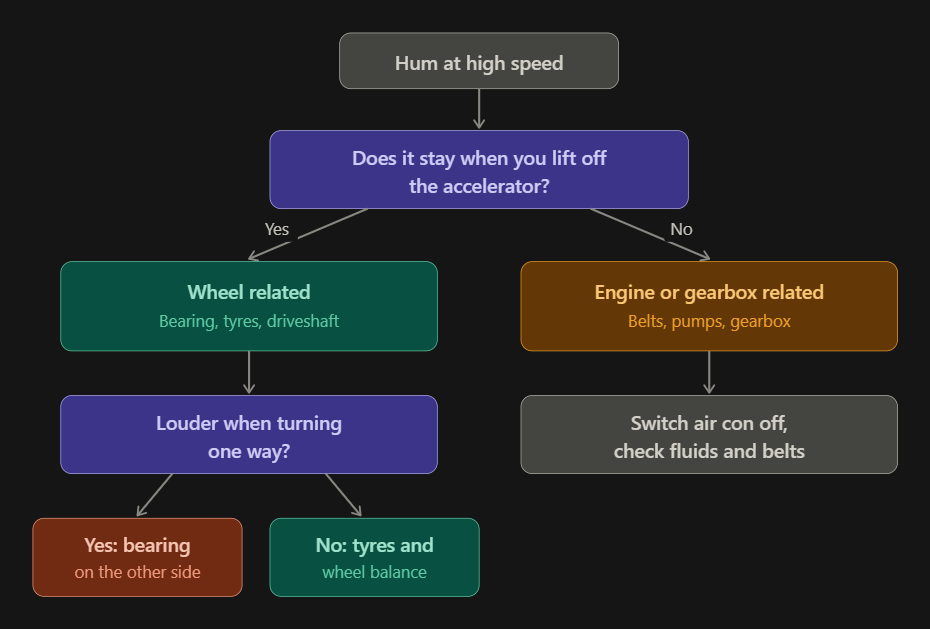
You do not need tools to gather useful information. The following checks take a few minutes on a quiet, safe road and give a garage a much better starting point.
- Note the speed range. Write down the speed at which the hum starts, where it peaks, and whether it fades at higher speed.
- Lift off the accelerator. Safely ease off the throttle while keeping the car in gear. If the hum stays the same, it is wheel related. If it changes or fades, it is engine or driveline related.
- Try gentle steering. On a straight, empty road, move the car slightly left and right within the lane. Note whether the hum changes with each direction.
- Compare road surfaces. Notice whether the noise changes between smooth and coarse tarmac.
- Switch the air conditioning off. If the noise disappears, the compressor is involved.
- Look and feel. When parked, inspect tyre tread across the full width and run a hand across it. Check for oil or fluid around the wheels and look for damage to the tyre sidewalls.
Avoid shifting an automatic car into neutral at speed to test the noise, and never do anything that distracts you from driving. If you are unsure, record a short clip with a passenger holding the phone and play it back for the garage.
Humming Noises and the MOT
The MOT does not fail a car for noise as such, but several of the causes above are test items in their own right.
The tester checks wheel bearings for play and roughness, assesses suspension and steering components for wear and checks tyre tread and condition. A bearing with noticeable play is a failure. A tyre below 1.6mm is a failure. Worn suspension joints or dampers that are leaking are also failure items. A hum that you have been ignoring can therefore become a failed test and a retest fee on top of the repair.
Resolving the noise before the test is almost always cheaper than discovering the cause on the day. Booking an MOT in Fleet at a centre that can also inspect and repair means a noise investigation, any necessary work and the test itself can be handled in one place. It is a practical option for drivers across Aldershot, North Camp and the surrounding area who would rather not shuttle a noisy car between garages.
What a Garage Will Do to Find the Cause
A competent diagnosis follows a logical order rather than guesswork:
- A road test with the technician listening for how the noise changes with speed, load, steering and gear.
- Wheels off the ground, spinning each one by hand to feel for roughness and rocking it to check for play in the bearing and suspension joints.
- A tyre inspection covering tread depth, wear pattern, sidewall condition and pressures.
- A fluid check on gearbox, differential and power steering fluid where fitted.
- A check of belts, pulleys and driven components under the bonnet.
- A scan for stored fault codes, including ABS sensor faults, which can accompany a failing hub.
A good garage explains what it found, shows you the worn part where possible and gives you a clear choice about timing. You should leave understanding the cause rather than simply authorising a repair.
If the humming noise persists, professional car repairs in Fleet can help identify the cause and determine the right repair.
Preventing a Humming Noise Before It Starts
Most causes of a high speed hum are linked to wear that can be slowed down with sensible habits.
| Habit | Why it helps |
| Check tyre pressures monthly | Prevents edge and centre wear that creates tyre noise |
| Rotate tyres at service intervals | Evens out wear and reduces cupping |
| Have alignment checked after a kerb or pothole strike | Stops uneven wear before it starts |
| Avoid potholes where safely possible | Protects bearings from impact damage |
| Replace worn shock absorbers promptly | Prevents scalloped tyre wear |
| Keep gearbox, differential and steering fluids in good condition | Protects bearings and gears from wear |
| Listen for new noises and act early | Catches wear while repairs are still simple |
Conclusion
A humming noise at high speed is one of the clearest early warnings a car can give, and it is almost always telling you something specific. If it follows road speed and stays the same when you lift off the accelerator, the cause lies at the wheels, in the tyres or in the bearings. If it follows engine speed, look at belts, pumps and the alternator. If it changes when you steer, a wheel bearing on the loaded side is the prime suspect. If it changes with the road surface, the tyres are the first thing to check.
The causes range from the trivial, such as a roof box or an open window, to the serious, such as a bearing that has begun to fail. What they share is that they rarely improve on their own. A tyre wearing into a scalloped pattern keeps wearing. A bearing that hums today grinds in a few months. A low fluid level that is ignored becomes a worn pump or gearbox.
The sensible response is neither panic nor patience. Run the simple road test, check your tyres, note what the noise does and book a proper inspection while the repair is still straightforward. Whether you drive daily through Fleet, take the A31 past Farnham, commute around Farnborough or run local errands through Ash Vale, the principle is the same. Quiet, smooth running at speed is what a healthy car feels like, and a new hum is the quickest way to find out that something is no longer right.
If you need help with your car, you can get directions to TJ Services Fleet and visit the garage in Fleet, Hampshire.
Frequently Asked Questions
Why does my car hum at high speeds?
The most common causes are a worn wheel bearing, uneven or noisy tyres, drivetrain wear in the differential or gearbox, low power steering fluid, and failing engine driven parts such as the alternator or water pump. The behaviour of the noise, especially whether it follows road speed or engine speed, shows which group the cause belongs to.
Is a humming noise from my car dangerous?
It can be. A faint hum from a tyre is low risk. A hum from a failing wheel bearing can progress to grinding, vibration and play in the wheel, which is a genuine safety issue. Any hum that is getting louder should be inspected promptly rather than monitored for months.
How can I tell if it is a wheel bearing or my tyres?
Tyre noise changes with the road surface and can move if the tyres are rotated. A bearing hum stays much the same on any surface and often changes when you steer. Checking the tread across the full width for cupping or feathering is the quickest way to rule tyres in or out.
Why does the hum get louder when I turn?
Cornering shifts weight onto the outside wheels, loading their bearings. If the hum is louder on a left bend, the right bearing is the likely cause. If it is louder on a right bend, suspect the left bearing. A garage confirms the exact wheel by checking each hub.
Can low gearbox or differential oil cause a hum?
Yes. Gear oil protects bearings and gears from wear, and low or degraded oil can cause whining or humming that changes with gear selection or with acceleration and coasting. Gearbox and differential oil are not always covered in a basic service, so it is worth asking about them on a higher mileage car.
Will a humming noise fail an MOT?
The noise itself is not a test item, but its causes often are. Play in a wheel bearing, tyres below 1.6mm and worn suspension or steering joints are all failure items, so a hum that has been ignored can turn into a failed test.
Can I keep driving with a humming noise?
A faint, steady hum with no vibration can usually be driven on carefully while you book an inspection, avoiding long high speed journeys. If it is accompanied by grinding, vibration, an ABS or warning light, a burning smell or a rising temperature gauge, stop driving and arrange recovery.
How do I stop it happening again?
Check tyre pressures monthly, rotate tyres regularly, have alignment checked after any kerb or pothole impact, replace worn dampers promptly, keep gearbox and steering fluids in good condition and book a regular service. Acting on a new noise early is the most effective prevention of all.
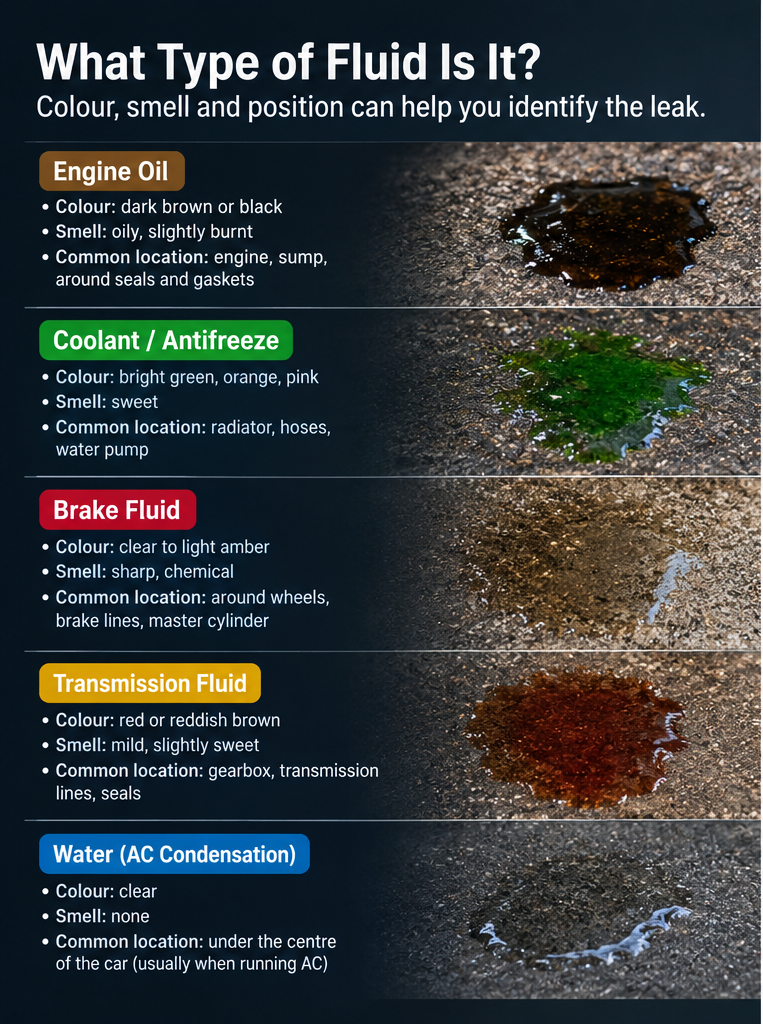
Finding a puddle under your parked car can be worrying. It could be engine oil, coolant, brake fluid or simply water from the air conditioning system. Some leaks are harmless, but others can affect your car’s safety or cause serious damage if you ignore them.
The colour, smell and location of the fluid can help you work out what might be leaking. However, these clues do not always reveal the exact cause. For example, dark fluid could be old engine oil, while coloured liquid near the engine could indicate a coolant leak.
In this guide, we explain how to identify common car fluid leaks, which warning signs to look for, when it may be unsafe to drive and how a technician can find the source of the problem.
The Colour and Feel Test: Identifying a Leak at a Glance
The fastest way to identify a leak is to examine the fluid itself. Place a sheet of white card or kitchen roll under the drip, or dab a small amount from the ground, and look at the colour, feel and smell. Always avoid touching fluids more than necessary and wash your hands afterwards, because many car fluids are harmful.
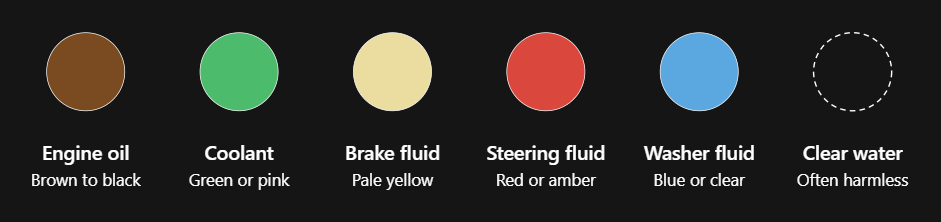
Colour is a strong clue but not a guarantee, because fluids darken with age and mix with dirt and road grime. Used alongside smell, texture and the position of the puddle, it narrows down the culprit quickly.
| Fluid | Typical Colour | Feel | Smell |
| Engine oil | Amber when fresh, dark brown or black when used | Slippery, slightly thick | Burnt or oily |
| Coolant | Green, pink, orange or blue | Thin, slightly slimy | Sweet |
| Brake fluid | Clear to pale yellow or light brown | Slippery, thinner than oil | Faint, slightly fishy or oily |
| Power steering fluid | Red, pink or amber | Thin and oily | Slightly burnt |
| Gearbox fluid | Red or brown | Oily, can be thicker | Strong, sharp |
| Washer fluid | Blue, green or clear | Watery | Soapy or like window cleaner |
| Petrol | Clear to pale yellow | Thin, evaporates fast | Strong and sharp |
| Diesel | Clear to yellow | Slightly oily | Distinctive and heavy |
Car Leaking Oil: The Most Common Fluid Leak
If the fluid is dark brown or black, slippery and smells oily, you almost certainly have a vehicle leaking oil. This is the leak most drivers meet first, and the causes are usually seals and gaskets that harden, shrink and crack with age and heat.
Engine oil is held in by a series of gaskets and seals, and each one is a potential weak point. The valve cover gasket sits on top of the engine and is a very common source, with oil running down the side of the block. The sump gasket or drain plug washer seals the bottom of the engine, and a plug that was not tightened correctly or a washer that was reused can drip slowly. The oil filter can leak if it was not fitted properly or if its seal has deteriorated. Crankshaft and camshaft seals, further inside the engine, can leak onto the belt or the bellhousing, while turbocharged engines have extra oil lines that can weep at their joints.
| Source of Leak | Typical Position | Common Cause |
| Valve cover gasket | Top and side of the engine | Gasket hardens and cracks with heat |
| Sump gasket or drain plug | Underneath the engine | Worn seal or incorrectly tightened plug |
| Oil filter | Side or underneath the engine | Loose filter or perished seal |
| Crankshaft seal | Front or rear of the engine | Seal wear with mileage |
| Oil cooler or turbo lines | Near the engine or turbo | Joints and hoses ageing |
| Damaged sump | Directly below the engine | Impact from road debris or a bump |
Why a Car Leaking Oil When Parked Looks Worse Than It Is
Many drivers notice a car leaking oil when parked more than while driving, and there are two reasons for this. First, hot oil continues to drain down and drip off components for some time after the engine is switched off, so the puddle forms after the car has stopped. Second, some seals only leak when the engine is cold or when it is off, because the seal relaxes without oil pressure holding it in place.
A small spot under the car after a long drive is a warning to investigate, not necessarily an emergency, but it should never be dismissed. Check the dipstick on level ground with the engine cool, and see whether the level is falling. A level that drops between services tells you the leak is real and ongoing.
What a Car Dripping Oil Does to the Engine
When a car is dripping oil, the immediate danger is the falling level. Oil does not get used up in a healthy engine, so any loss is a loss that must be explained. If the level drops far enough, the oil pump begins to draw air, pressure falls and parts that rely on a film of oil start to wear against each other. The red oil pressure warning light is the final alarm, and if it comes on while driving, stop safely as soon as possible and switch off the engine.
There are secondary problems too. Oil that drips onto hot exhaust components can smoke and create a burning smell, and in rare cases it can become a fire risk. Oil on rubber hoses and mounts can soften and perish them, and oil on the drive belt can make it slip.
Oil Leaking Inside the Car: What It Usually Means

Finding a greasy or sticky fluid inside the cabin is alarming, and it is worth being precise about what it might be. Genuine engine oil inside the passenger compartment is unusual, because the engine oil system sits well away from the cabin. More often, an oil leaking inside car report turns out to be one of the following.
| What You Find | Likely Source | Why It Matters |
| Sweet smelling damp carpet, misted windows | Coolant from a leaking heater matrix | Overheating risk, health hazard from fumes |
| Oily or slippery fluid near the pedals | Brake or clutch fluid from the master cylinder | Safety critical, do not drive |
| Oily residue on the boot floor | Rear axle, fuel or spilled containers | Needs inspection |
| Oil smell through the vents | Oil dripping onto hot exhaust, drawn into the air intake | Indicates an active external oil leak |
| Damp patches after rain | Water from a blocked drain or poor seal | Mould and electrical problems |
If the fluid is near the pedals and feels slippery, treat it as a brake or clutch fluid leak until proven otherwise and do not drive the car. If you smell oil through the ventilation, the leak is probably outside the cabin and being drawn in with the air, which still needs to be traced.
Water Dripping Under Your Car: Is It Normal?
Not every puddle is a problem. A clear, odourless puddle is the most common thing drivers find, and often it is harmless. The challenge is knowing the difference between harmless water and a coolant leak that has been diluted or is only just beginning.
Air conditioning is the most frequent cause of water dripping from car underneath. The system removes moisture from the cabin air, and that water drains out through a small tube, usually near the front on the passenger side. On a warm day, a steady drip of clear water after using the air conditioning is exactly what should happen. Exhaust condensation is another normal source, because the exhaust gases contain water vapour that condenses inside the pipe, especially after short cold journeys, and drips from the tailpipe.
Water dripping under the car that behaves differently deserves a closer look. If the liquid is coloured, sweet smelling, slippery or continues when the air conditioning has been off for hours, it may be coolant. A car that leaks water underneath after rain could also have blocked sunroof or scuttle drains, sending water down the wrong path.

| Water Related Drip | Where You See It | Normal or Not |
| Air conditioning condensation | Front, usually passenger side, after using the air conditioning | Normal |
| Exhaust condensation | Tailpipe, especially on cold starts and short trips | Normal |
| Washer fluid leak | Near the front wheel arch or washer bottle | Not normal, needs repair |
| Coolant leak | Front of the engine, radiator area, near hoses | Not normal, urgent |
| Blocked drain overflow | Sills, footwells or under the doors after rain | Not normal, needs attention |
| Windscreen or door seal leak | Inside the cabin after rain | Not normal, causes damp and corrosion |
Where Is the Leak? Reading the Position of the Puddle
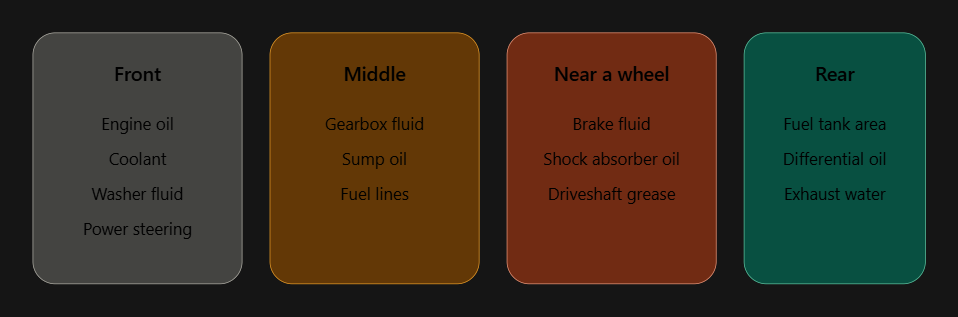
The location of the puddle is one of the most useful clues you have. Fluids tend to drip close to where they leak, although airflow and the slope of the ground can carry them some distance.

| Stage | What Is Happening | What the Driver Notices |
| Early | A gasket or seal begins to harden or crack | A faint damp patch, a slight smell of hot oil |
| Developing | The gap widens and oil escapes more freely | Spots on the drive, a slowly falling dipstick level |
| Advanced | Oil level drops noticeably, parts run with less protection | Smoke from the engine bay, low oil warning |
| Severe | The engine runs short of oil and wear accelerates | Knocking, loss of power, oil pressure light, possible engine failure |
A vehicle leaking oil at the early stage is usually a straightforward repair involving a single gasket or seal. The same leak left for months can contaminate belts and hoses, coat the engine in grime that hides other faults and, in the worst case, end in engine damage that is far more disruptive than the original problem.
The Safe Home Check: A Simple Way to Identify a Leak
You do not need tools to gather useful information. A few minutes of careful checking gives a technician a head start and helps you decide how urgent the situation is.
- Park on level ground and place a large sheet of clean cardboard or white paper under the engine area overnight
- Check the colour, texture and smell of any drops, and note exactly where they landed
- Photograph the cardboard in good light, because the pattern is useful evidence
- With the engine cold and the car level, check the oil dipstick, coolant expansion tank and brake fluid reservoir against their minimum and maximum marks
- Look under the bonnet for wet, shiny or grimy areas, but do not touch anything hot or open the coolant cap while the engine is warm
- Check the dashboard for oil pressure, coolant temperature or brake warning lights
- Note when the leak happens, such as only after parking, only when driving, or only when the air conditioning is on
Do not wash the engine bay before the check if you can avoid it, because a clean engine with fresh drips is easier to diagnose than one that has just been pressure washed, and never wash spilled fluid into a drain. Small spills on a driveway can be soaked up with absorbent material and disposed of through your local council waste facility.
Should You Keep Driving With a Leak?
The honest answer depends on the fluid and the amount. A short, careful journey may be reasonable in some cases, but several situations mean the car should not be driven at all.
| Situation | Advice |
| Brake pedal feels soft or fluid is near the wheels or pedals | Do not drive, arrange recovery |
| Strong smell of fuel or visible fuel dripping | Do not drive, keep away from ignition sources |
| Red oil pressure warning light on | Stop safely and switch off the engine |
| Temperature gauge rising or coolant warning light | Stop safely, allow to cool, do not open the cap hot |
| Oil level near or below the minimum mark | Top up with the correct oil and arrange an inspection before further driving |
| Small oil drips but level is stable | Drive carefully, check the level often, book a repair soon |
| Clear water after using air conditioning | Normal, no action needed |
If you do need to top up a fluid to get to a garage, use the correct specification for your vehicle, because the wrong oil or coolant can cause its own problems. The handbook or the filler cap markings will tell you what is needed.
How a Technician Finds the Source of a Leak
Finding where a fluid comes from is often harder than it sounds, because fluid runs, drips and gets blown around by airflow. A methodical diagnosis avoids replacing the wrong part.
The car is raised and the area is inspected from above and below. The suspect area is cleaned thoroughly so that fresh fluid is easy to spot, and the engine is run while the technician looks for the original point of escape. For stubborn leaks, a UV dye can be added to the fluid, and a special lamp then shows exactly where it emerges. Cooling systems can be pressure tested to reveal leaks that only appear under pressure, and brake systems are checked for pipe corrosion, hose damage and caliper or master cylinder leaks.
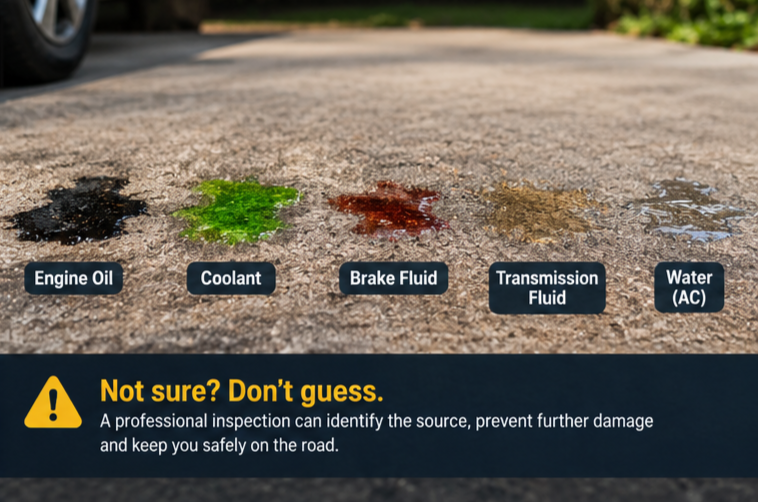
The goal is to identify the actual cause rather than the most visible symptom. An oil patch near the sump might come from a leaking valve cover higher up, and replacing the sump gasket would not stop it. Clear, evidence based diagnosis saves time and prevents repeat repairs.
Because fluid leaks can come from several different components, professional inspection and car repairs in Aldershot can help identify the source and prevent the fault from getting worse.
How Fluid Leaks Affect Your MOT
Leaks are taken seriously at an MOT test because they can affect safety, the environment and the reliability of the vehicle. A brake fluid leak or a fuel leak is a significant safety concern and can result in an immediate failure. A leak that is dripping or presents an environmental or fire risk can also be recorded as a defect that needs repair, while a light seep may be noted as a lower level issue.
Fluid Leaks and Your Vehicle Warranty
A common worry is that having a leak repaired, or the car serviced, away from a main dealer will affect a manufacturer warranty. In general, a car can be serviced and repaired at an independent garage without invalidating a warranty, provided the work follows the manufacturer’s schedule, uses parts of the correct specification and is properly recorded. The details depend on the terms of your own warranty, so it is sensible to read them, but good record keeping is the most important protection.
The practical point for leak repairs is that a clear invoice showing the fault, the parts fitted and the fluid specification used is valuable evidence, both for the warranty and for the vehicle’s service history.
How Regular Servicing Helps Prevent Leaks
Many leaks develop slowly, and a service is the best opportunity to catch them early. During a service, a technician checks fluid levels, inspects hoses, pipes and seals for dampness, looks underneath for signs of weeping and replaces oil and filters with new seals. Old oil and tired filters can put extra strain on seals, so changing them on schedule helps protect the gaskets that hold the oil in.
Fluids themselves also age. Brake fluid absorbs moisture over time and can corrode the system from the inside, and coolant loses its protective additives, which can lead to internal corrosion and eventually to leaks from the radiator, pump or heater matrix. Replacing these fluids at the recommended intervals protects the components that hold them.
Regular inspections can help identify leaking hoses, worn seals and fluid loss before they lead to more serious problems. Ash Road Service Centre can help drivers assess vehicle problems and understand the repairs needed.
| Service Check | What It Can Reveal | Leak Prevented or Caught |
| Oil and filter change | Fresh oil and new seals | Filter and drain plug leaks |
| Underbonnet inspection | Damp or grimy gaskets and hoses | Early valve cover and hose leaks |
| Underside inspection | Wet sump, gearbox or driveshaft seals | Slow weeps before they become drips |
| Brake fluid test | Moisture content and condition | Corrosion that leads to brake leaks |
| Coolant test | Strength and condition | Corrosion in the cooling system |
| Hose and pipe check | Perished or swollen rubber | Coolant and power steering leaks |
Common Myths About Car Leaks
| Myth | The More Accurate Picture |
| A small oil leak is nothing to worry about | Small leaks grow, and the falling oil level can damage the engine |
| Thicker oil will stop a leak | It may slow a leak briefly, but it does not repair a failed seal and can cause other problems |
| Leak stop additives are a permanent fix | They are at best a temporary measure and can affect seals and passages |
| All water under the car is harmless | Clear water is often harmless, but coloured or sweet smelling liquid may be coolant |
| If the warning light is off, the level is fine | Warning lights often come on only when the situation is already serious |
| Leaks only matter if they leave a puddle | Many leaks evaporate or burn off on hot parts and leave no puddle |
| Topping up is the same as repairing | Topping up replaces the fluid, but the leak continues |
Conclusion
A car leaking fluid is trying to tell you something, and learning to read the message is one of the most valuable habits a driver can build. The colour tells you where to start, the smell and feel narrow the options, and the position of the puddle points towards the likely source. A dark, slippery patch means a car leaking oil, a bright and sweet smelling liquid suggests coolant, a pale slippery fluid near the wheels or pedals points to the brakes, and clear, odourless water after using the air conditioning is usually nothing to worry about at all.
What matters most is how different leaks deserve different responses. Some, such as brake fluid and fuel, mean the car should not be driven. Others, such as engine oil and coolant, may allow a careful trip to a garage but become dangerous if the level falls too far, and a few, such as condensation and washer fluid, are low risk. The mistake is treating all of them the same, either panicking over harmless water or ignoring a slow oil leak because the car still seems to run perfectly.
The practical approach is simple. Note the colour, smell and position, check the fluid levels, watch for warning lights and avoid pushing on if anything feels wrong. Arrange a proper inspection rather than relying on top ups, because the aim is to stop the leak, not hide it. Combined with regular servicing, which catches weeping seals and ageing hoses early, and with a check before each MOT, this approach keeps small leaks small, protects the engine and the other systems that rely on those fluids, and gives you confidence that the next patch on the drive will be nothing more than a harmless puddle of water.
If you need help with a suspected fluid leak, you can read Ash Road Service Centre reviews on Google before contacting the garage about an inspection.
Frequently Asked Questions
Why is my car leaking oil when parked?
Hot oil continues to drain off components after the engine stops, and some seals relax and leak once oil pressure disappears. A car leaking oil when parked usually has a failing gasket or seal, and the level should be checked and the source traced.
Is it safe to drive a vehicle leaking oil?
It depends on how fast the level is falling. A small drip with a stable level may allow careful driving to a garage, but if the level is low or the oil pressure light comes on, stop and avoid driving further.
Why is there oil leaking inside my car?
True engine oil inside the cabin is unusual. A greasy or damp patch inside is more often coolant from a heater matrix, brake or clutch fluid near the pedals, or an external oil leak whose smell is drawn in through the vents.
Is water dripping under my car normal?
Often yes. Clear, odourless water from the front passenger side after using the air conditioning, or from the tailpipe on a cold start, is normal. Coloured, sweet smelling or slippery liquid is not.
Why does my car leak water underneath after rain?
Blocked sunroof or scuttle drains, or worn door and windscreen seals, can send rainwater into places it should not go. This can lead to damp carpets, mould and electrical faults, so it should be checked.
What colour is a coolant leak?
Coolant is commonly green, pink, orange or blue, with a sweet smell. It is thinner than oil and slightly slimy to the touch.
Can a leak cause an MOT failure?
Yes. Brake fluid and fuel leaks can cause a failure, and an oil or other fluid leak that is dripping or poses an environmental or fire risk can also be recorded as a defect. Light seepage is often an advisory.
Will repairing a leak at an independent garage affect my warranty?
Generally not, provided the work follows the manufacturer’s requirements, uses correct parts and fluids and is properly documented. Check the terms of your own warranty if you are unsure.
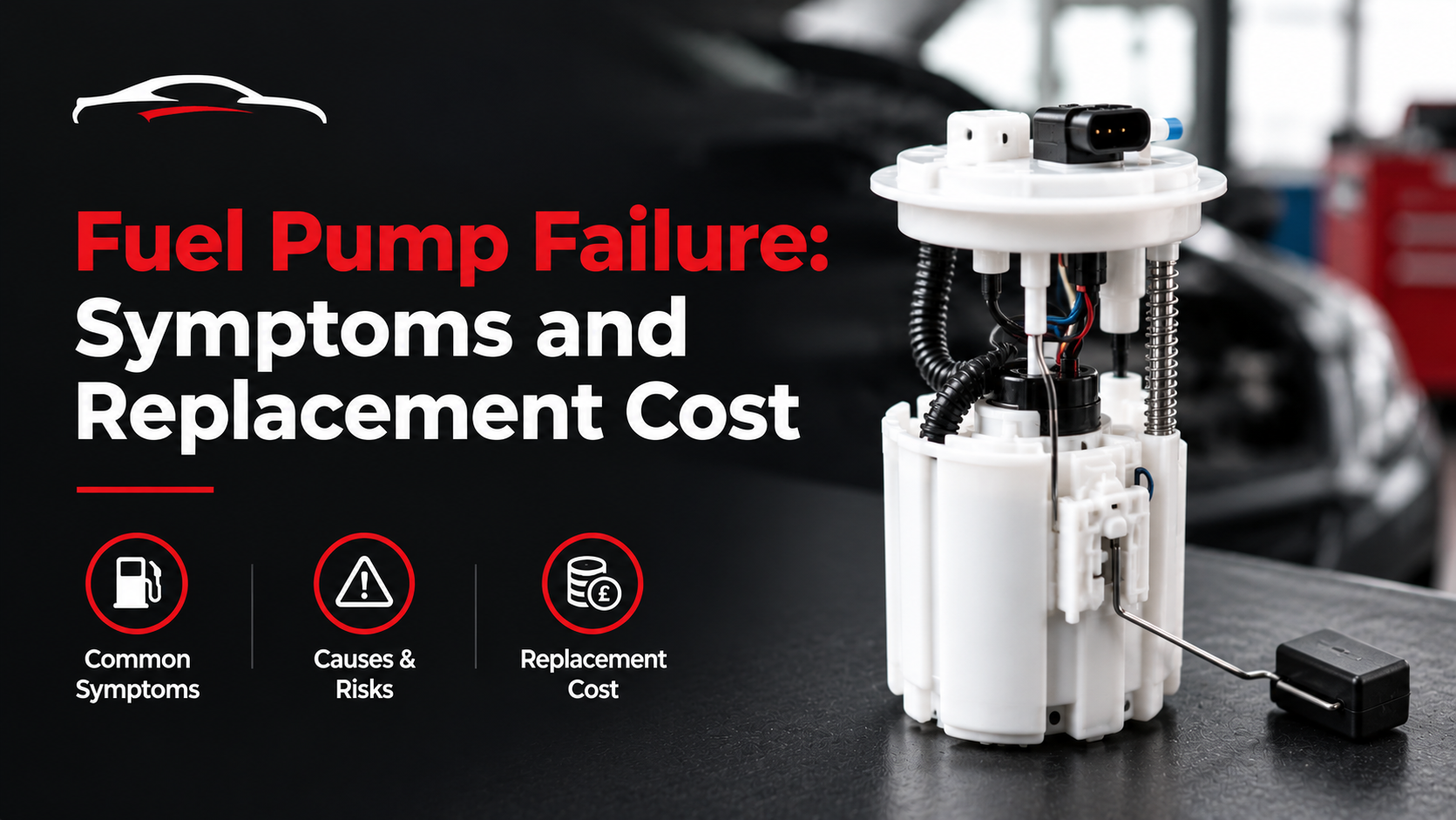
Learn the symptoms of fuel pump failure, why pumps fail, how faults are diagnosed, and what affects the cost of a replacement.
A car that cranks but refuses to start, hesitates on a hill, or cuts out in traffic can leave any driver anxious, and a failing fuel pump is one of the most common reasons behind these symptoms. A driver in Aldershot may notice the engine losing power when accelerating onto a dual carriageway, or struggling to fire up after being parked overnight, without any obvious warning light to explain why. Because the fuel pump sits out of sight, usually inside the tank, its decline often goes unnoticed until the symptoms become hard to ignore. Catching it early, ideally during regular car servicing, can mean the difference between a planned repair and a roadside breakdown.
This guide explains what a fuel pump does, the symptoms of failure, why pumps fail, how the fault is diagnosed, what replacement involves, and what influences the cost. Understanding each stage helps you spot problems sooner and have a clearer conversation with your technician.
What a Fuel Pump Does
The fuel pump moves fuel from the tank to the engine at the pressure the fuel system needs. Without a steady, correctly pressurised supply, the injectors can’t deliver the right amount of fuel, and the engine runs badly or not at all. In most modern cars the pump is electric and sits inside the fuel tank, where the surrounding fuel helps cool and lubricate it.
Diesel cars often use more than one pump. A low pressure pump moves fuel from the tank toward the engine, while a separate high pressure pump on the engine raises the pressure to the very high levels common rail systems need. The overview below shows the basic path fuel takes.


Here is what each sign usually looks like in everyday driving.
- The engine cranks but won’t start. If the pump has failed completely, no fuel reaches the engine. A healthy pump normally produces a brief hum for a second or two when the ignition is switched on, so silence from the rear of the car can be a clue.
- Loss of power under load. Climbing a hill, towing, or accelerating hard asks for more fuel. A weak pump can’t keep up, so the engine feels flat or hesitates. A driver in Farnborough might first notice this when joining a busy road from a slip road.
- Sputtering at speed. The engine may jerk or surge at a steady cruise as fuel delivery becomes inconsistent.
- Stalling, especially when hot. A worn pump motor can struggle once it’s warm, then recover after cooling. A driver in Ash who has a car that cuts out after a long drive and restarts later is describing a classic pattern.
- A whining or humming noise from the tank. Some noise is normal, but a loud, rising whine can signal a pump that’s wearing out.
- Hard starting. The engine may take several turns of the key to fire, particularly after the car has been standing.
- Reduced fuel economy or a warning light. A poor fuel supply can upset the fuel mixture, and the engine management light may come on with codes relating to fuel pressure or a lean mixture.
Symptoms That Look Like a Fuel Pump Problem but Aren’t
Many of these symptoms can have other causes, so a fuel pump shouldn’t be blamed without testing. The table below shows some of the common lookalikes.
| Symptom | Fuel Pump Cause | Other Possible Causes |
| Cranks but won’t start | No fuel delivery | Faulty crankshaft sensor, ignition fault, immobiliser issue |
| Loss of power under load | Weak pressure | Blocked fuel filter, clogged catalytic converter, airflow sensor fault |
| Stalling when hot | Heat affected pump motor | Failing sensor, ignition component, charging fault |
| Hesitation and surging | Inconsistent pressure | Dirty injectors, vacuum leak, faulty throttle component |
| Hard starting | Pressure leaks down | Weak battery, worn spark plugs, starter problem |
This overlap is exactly why diagnosis matters. Replacing a pump that was never faulty wastes time and leaves the real problem untouched.
Why Fuel Pumps Fail
Fuel pumps are built to last, but several factors shorten their working life.
- Normal wear. The electric motor and its internal parts wear with use, so mileage and age are the most common causes.
- Regularly running the tank very low. Fuel helps cool and lubricate an in tank pump, so habitually driving on a nearly empty tank can make it work hotter and wear faster.
- A clogged fuel filter. A blocked filter forces the pump to work harder against resistance, which strains it over time.
- Contaminated fuel. Dirt, rust, or water in the fuel can damage the pump and block the filter and strainer.
- Electrical faults. A failing relay, a corroded connector, damaged wiring, or low voltage can stop the pump from working properly even when the pump itself is healthy.
- Wrong fuel. Putting petrol in a diesel car, or the reverse, can cause serious damage, because the pump relies on the fuel for lubrication. If this happens, the engine shouldn’t be started, and the car should be taken to a technician instead.
A driver in Ash Vale with an older, higher mileage car should treat early symptoms seriously, since age is the biggest single factor in pump failure.
How a Failing Fuel Pump Is Diagnosed
A good diagnosis confirms the fuel pump is the cause before any work begins. The usual steps include:
- Listening for the pump’s priming hum when the ignition is switched on.
- Scanning for fault codes and reading live data, including readings that show whether the engine is running lean.
- Checking the pump’s fuse and relay.
- Measuring the voltage and earth at the pump connector, since poor electrical supply can mimic a failing pump.
- Testing fuel pressure with a gauge and comparing it with the manufacturer’s specification.
- Checking the fuel filter, where one is fitted, to rule out a blockage.
- Ruling out other causes, such as sensors and ignition components.
A driver in Farnham whose car only misbehaves occasionally faces an extra challenge, because a pump that works most of the time is hard to catch in the act. Problems like this behave much like the faults explained in this guide on why car faults come and go, and they’re often tracked down by recording live data during a road test and recreating the conditions in which the symptoms appear.
Can You Keep Driving With a Failing Fuel Pump?
It’s not advisable. A pump that’s struggling can fail without warning, and the most likely moment is when the engine is working hardest, such as overtaking, joining a motorway, or pulling out of a junction. Losing power or stalling in those moments creates a genuine safety risk.
Even if the car seems to run acceptably between episodes, the underlying fault won’t improve. If you suspect a failing pump, it’s sensible to avoid long journeys and busy roads and arrange an inspection as soon as practical.
Fuel Pump Replacement: What’s Involved
Replacing a fuel pump is a more involved job than many drivers expect, largely because of where the pump lives. On some cars there’s an access panel beneath the rear seat or in the boot floor, which makes the job simpler. On others, the fuel tank has to be lowered to reach the pump, which takes considerably longer.
Because the work involves fuel and its vapour, it carries real safety risks and is best left to a trained technician. The process generally includes:
- Safely relieving fuel system pressure and disconnecting the battery.
- Gaining access to the pump, either through a panel or by lowering the tank.
- Removing the pump, which is often part of an assembly that includes the fuel level sender and a strainer.
- Fitting the new pump or assembly with new seals.
- Replacing the fuel filter where one is fitted and due, since a blocked filter could shorten the new pump’s life.
- Refitting everything, priming the system, checking for leaks, and confirming correct fuel pressure.
- Scanning for fault codes and road testing the car.
Fuel Pump Replacement Cost: What Affects the Price
The cost of replacing a fuel pump varies widely, and a single figure would be misleading. What matters is understanding what drives the final bill so that you can compare quotes sensibly. The diagram below shows the main factors.

| Factor | How It Affects the Cost |
| Make and model | Parts and labour times differ between vehicles, and some pumps are far more expensive than others |
| Access to the pump | A rear seat or boot access panel is quicker than lowering the fuel tank, which increases labour time |
| Pump or full assembly | Some cars need the whole module replaced, including the level sender and housing, rather than the pump alone |
| Parts quality | Original equipment, quality aftermarket, and budget parts differ in price and expected lifespan |
| Fuel filter and seals | Replacing the filter, seals, and related parts alongside the pump adds to the total but protects the repair |
| Diagnosis | Confirming the fault takes time, though it prevents replacing the wrong part |
| Related electrical faults | A faulty relay, fuse, or wiring may need repair too |
A driver in Tongham comparing quotes should check that each one covers the same work, particularly whether the filter, seals, and diagnosis are included. The cheapest quote isn’t always the best value if it leaves out parts that will need doing soon afterwards. Asking for a clear breakdown of parts and labour is always reasonable, and a reputable garage will be happy to provide one.
Fuel Pump Failure and the MOT
A fuel pump isn’t tested as a separate item in the MOT, but the fuel system is checked for leaks, and a fuel cap that is missing or doesn’t seal properly can cause a fail. A persistent engine management light, which may accompany fuel delivery faults, can also lead to a fail on cars where it applies. A badly running engine can also struggle with the emissions part of the test.
If your car is showing symptoms of fuel supply trouble, it’s wise to sort the problem before the test rather than hoping it passes. Booking an MOT in Aldershot with enough time to carry out any necessary repairs avoids a rushed fix or a fail that could have been predicted.
Check Your Vehicle Details Before Ordering Parts
Fuel pumps are specific to the car’s make, model, engine, and fuel type, and a part that looks similar can be wrong in a way that only shows up after fitting. Having accurate vehicle information makes sure the right component is chosen. It’s useful to check the DVLA record for your car so that the registration details, engine information, and first registration date you quote are correct.
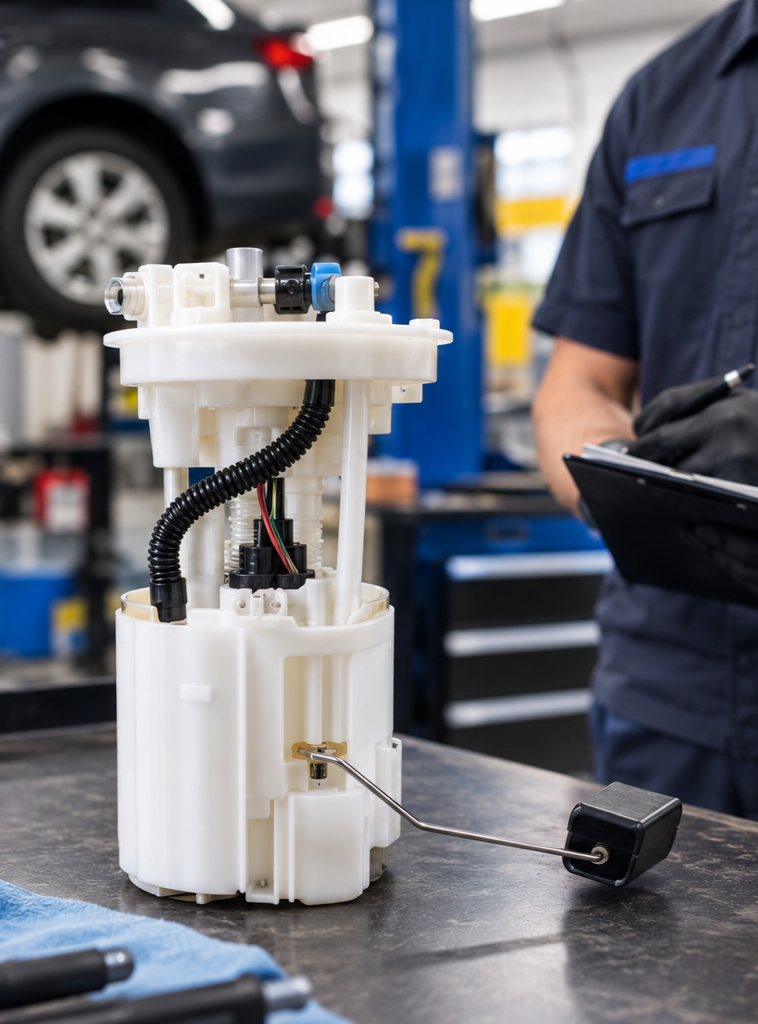
This also matters if you’re buying a used car. A vehicle with a history of stalling or hard starting deserves a proper inspection before purchase, since a fuel system fault can be expensive to discover afterwards.
How to Help Your Fuel Pump Last Longer
You can’t make a fuel pump last forever, but a few habits reduce unnecessary strain.
- Avoid regularly running the tank close to empty, since fuel helps cool and lubricate an in tank pump.
- Replace the fuel filter at the intervals recommended for your car, where a filter is fitted.
- Use fuel from reputable, busy stations to reduce the chance of contamination.
- Never put the wrong fuel in the car, and if it happens, don’t start the engine.
- Fix electrical faults, such as a failing relay or corroded connector, promptly.
- Pay attention to early symptoms such as hesitation, hard starting, or unusual noise from the tank.
- Keep to the service schedule so that small fuel system issues are spotted early.
A driver near North Camp who gets into the habit of refuelling at a quarter of a tank, rather than at the last moment, is doing the pump a quiet favour.
Common Myths About Fuel Pump Failure
A few misunderstandings lead drivers to the wrong conclusion.
Myth one, a car that cranks but won’t start must have a dead pump. Plenty of other faults, including sensors and ignition problems, produce the same symptom. Myth two, if the car recovers, the pump is fine. A pump that works intermittently is usually on its way out. Myth three, you only need to replace the pump, never the filter. A blocked filter can strain and shorten the life of a new pump. Myth four, a fuel additive will fix a worn pump. Additives can’t repair a worn motor. Myth five, fuel pump work is a simple job. The pump sits in the tank, and the work involves fuel vapour and safety risks, so it’s best carried out by a professional. A driver in Fleet who hears these claims should remember that proper diagnosis comes first.
Conclusion
A failing fuel pump tends to announce itself through a recognisable set of symptoms: difficulty starting, loss of power under load, sputtering, stalling when hot, and a whine from the tank area. Because these signs overlap with problems in the filter, sensors, ignition, and electrical system, confirming the cause through testing is essential before any replacement.
When a pump does need replacing, the job’s complexity depends heavily on access to the pump, the type of vehicle, and whether the whole assembly and related parts are involved, which is why the cost varies so much. Looking for a clear, itemised quote and a garage that explains its diagnosis is the best way to avoid surprises. Acting at the first sign of trouble, keeping the fuel filter maintained, and avoiding running the tank dry all help to protect the pump and keep you safely on the road around Aldershot and beyond.
Frequently Asked Questions
What are the first signs of a failing fuel pump?
Typical early signs include hesitation under load, hard starting, a whining noise from the tank area, and occasional stalling, especially when the engine is hot.
Can a fuel pump fail without warning?
Yes. Some pumps decline gradually, but others can stop suddenly, leaving the engine unable to run.
How long does a fuel pump replacement take?
It depends on access. A car with an access panel is quicker, while one that needs the fuel tank lowered takes noticeably longer.
Why is the cost of replacement so variable?
It depends on the vehicle, how the pump is accessed, whether the whole module or just the pump is needed, the quality of the parts, and whether the filter and seals are replaced at the same time.
Is it safe to drive with a failing fuel pump?
It isn’t recommended, because the pump can fail without notice, causing power loss or stalling, particularly in busy traffic or at speed.
Can a blocked fuel filter be mistaken for a bad fuel pump?
Yes. A blocked filter causes very similar symptoms, which is why it’s checked as part of the diagnosis.
Business
1,000+ Big Island Weddings Later: A Local Officiant Shares 3 Secrets to an Unforgettable Ceremony


After officiating more than 1,000 elopements and weddings in Kailua-Kona, Hawaii, I’ve learned that no two ceremonies are ever quite the same. I’ve witnessed couples exchange vows beneath clear blue skies, during gentle tropical rain showers, against dramatic volcanic landscapes, and as the sun sets over the Pacific. As a Big Island wedding officiant, I’ve had the privilege of being part of countless love stories. Over the years, those experiences have revealed a few important lessons about what truly makes a Hawaii wedding memorable. For couples planning a destination wedding or elopement on the Big Island, these are three lessons I’ve learned from more than 1,000 ceremonies.
Three Lessons from More Than 1,000 Big Island Weddings
1. Joy Matters More Than Perfection
After witnessing more than 1,000 wedding ceremonies, one lesson stands out: the most memorable weddings are not necessarily the most elaborate. They are the ones where couples are genuinely present and enjoying the moment.
Wedding days can come with expectations, nerves, and pressure to make everything perfect. But when couples focus on their commitment to each other rather than worrying about every detail, the atmosphere changes. Family members relax, guests share in the excitement, and the ceremony becomes a meaningful reflection of the couple’s relationship.
In my experience, the happiest moments often happen when couples let go of expectations and simply enjoy being together.
2. Kona Weather Doesn’t Always Follow the Forecast
One of the most common questions I receive from couples planning a Hawaii wedding comes just days before their ceremony: What happens if the forecast calls for rain?
The answer is that weather on the Big Island can be unpredictable, particularly along the Kona coast. The island’s varied terrain creates distinct microclimates, meaning conditions can differ significantly from one area to another.
A weather app might predict rain for the region while the beach where a couple plans to marry remains sunny. Conditions can also change quickly, so a forecast several days in advance does not always tell the whole story.
After years of performing ceremonies along the Kona coast, I’ve learned that flexibility is essential. Rather than letting an early forecast overshadow the excitement of the occasion, couples can monitor local conditions as their wedding day approaches and prepare for the possibility of changing weather.
3. The Happiest Couples Don’t Sweat the Small Stuff
A wedding rarely unfolds exactly as planned. A sudden rain shower, a gust of wind, or a small scheduling change can become part of the experience.
I’ve found that couples who approach these moments with a sense of humor and flexibility often enjoy their ceremonies the most. They understand that the purpose of the day isn’t to execute a flawless production. It’s to celebrate their relationship and the commitment they’re making to one another.
That relaxed attitude can also make a difference in their photographs. When couples feel comfortable and enjoy themselves, their emotions come through naturally, creating images that reflect the genuine happiness of the occasion.
After more than 1,000 ceremonies, I’ve come to believe that a memorable wedding isn’t defined by perfect weather or a perfectly executed schedule. It’s defined by the people, the commitment, and the joy they share.
Planning a Big Island Wedding?
For couples considering a Hawaii destination wedding or elopement, choosing an experienced local officiant can help make the planning process easier and the ceremony more personal.
At Kona Wedding Officiant®, our team serves couples throughout the Kona area, offering personalized ceremonies and all-inclusive wedding packages designed to make getting married on the Big Island a memorable experience.
Learn more about our wedding services at Kona Wedding Officiant® or explore our Hawaii wedding officiant services.

6 Key Qualities to Look for in a High-Quality Greens Supplement

Top Reasons to Consider Cosmetic Surgery in Turkey

Why Does My Car Make a Humming Noise at High Speeds?

Who Is Rita Johal? All About Riyad Mahrez’s Former Wife and Her Story

Who Is Caroline Hickman? Story of Caroline Hickman, Steve Coogan’s Ex Wife

Who is Sarah Vincent? All About Vic Reeves’ Ex Wife and Their Children
-
 Celebrity4 months ago
Who Is Rita Johal? All About Riyad Mahrez’s Former Wife and Her Story
-
 Celebrity4 months ago
Who Is Caroline Hickman? Story of Caroline Hickman, Steve Coogan’s Ex Wife
-
 Celebrity4 months ago
Who is Sarah Vincent? All About Vic Reeves’ Ex Wife and Their Children
-
 Celebrity4 months ago
The Life of Giselle Glasman: Actress, Theatre Publicist, and Lennie James’ Wife
-

 Celebrity4 months ago
Who Was Carolyn Cox? Biography of Nigel Havers’ Ex Wife
-

 Celebrity4 months ago
Who Is Annie Milner? Untold Story of Paul McGann’s Former Wife
-

 Celebrity4 months ago
Story of Merula Salaman and Her Life with Alec Guinness
-

 Celebrity4 months ago
Who is Eleasha Hamed? Boxing Legend Naseem Hamed’s Wife