Fashion
You Are Come Too Late: The MacLellans, Threave Castle, and a Kilt Built for Throwing

In the early months of 1452 Sir Patrick Gray rode into Galloway with a letter from the King of Scots. He was carrying it to Threave Castle, the great tower of the Black Douglases on its island in the River Dee, and it demanded the release of a prisoner: Sir Patrick MacLellan of Bombie, the tutor of the MacLellans, who had refused to join the Earl of Douglas in a private league against the Crown and had been seized for it. MacLellan was Gray’s nephew, his sister’s son.
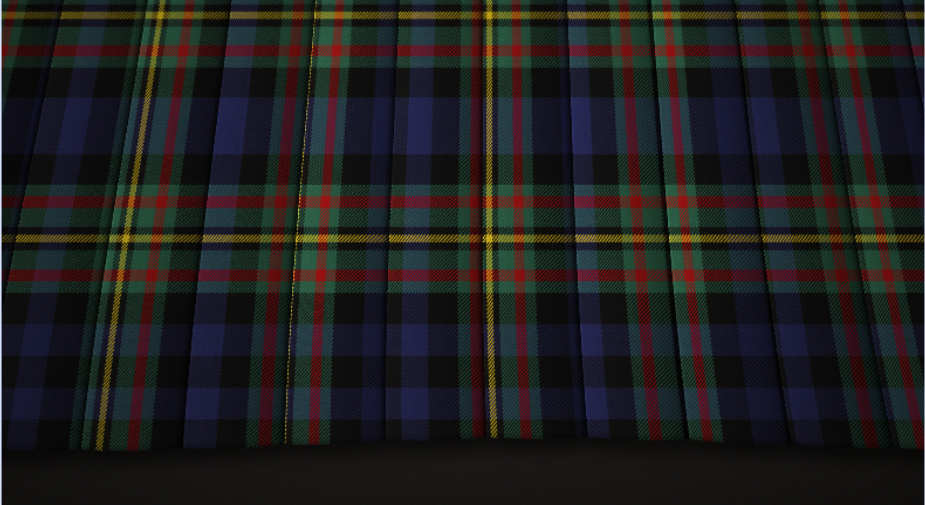
Threave was the strongest castle in the south-west, a great grim tower built by Archibald the Grim in the 1370s on an island in the river, and it had a gallows knob over the door from which, its lord liked to say, the rope was never allowed to want a tassel. William, eighth Earl of Douglas, received Gray with courtesy and asked him to dine before any business was discussed. Gray, who knew the man, said he would rather deliver the letter first. The Earl insisted. They ate. And while they ate, the Earl sent a servant down to the dungeon and had MacLellan brought out and beheaded in the courtyard. The MacLellans survived it, and their name is carried now by a bright blue and black cloth, the MacLellan tartan.
When the meal was over the Earl read the King’s letter, professed himself entirely willing to obey it, and led Gray out to the yard, where the body lay under a cloth. “Sir Patrick,” he said, “you are come a little too late. Yonder is your sister’s son lying, but he wants the head. Take his body and do with it what you will.” Gray rode for his life, with the Douglas men after him, and reached Edinburgh. The King, James II, invited the Earl to Stirling Castle under safe conduct a few weeks later, argued with him after dinner, and stabbed him to death with his own hand. The Douglas power was broken within three years.
The story is from the chronicler Pitscottie, who wrote a century later and improved things, and the exact words are his. The murder, the letter and the King’s revenge are matters of record.
Think on
The MacLellans of Bombie recovered. Their lands were around Kirkcudbright, on the Solway coast of Galloway, and their family story has one more beheading in it, this time on the right side. In the 1450s, the tradition goes, a band of outlaws led by a man called the Black Morrow, sometimes described as a Moor and sometimes as a gypsy, was terrorising the district, and the King offered the barony of Bombie to whoever would rid him of it. Sir William MacLellan, the murdered man’s son, found the Black Morrow asleep and cut off his head, carried it to the King on the point of his sword, and got the lands. The clan’s crest is still a Moor’s head on a sword, and its motto, Think On, is the warning the head is supposed to give.
They built MacLellan’s Castle in the middle of Kirkcudbright in 1582, which stands there still, roofless and grand, and they were made Lords Kirkcudbright in 1633. The peerage went dormant in the eighteenth century, and there has been no chief since. But the name is everywhere in Galloway and, in the spellings MacLellan, McLellan, MacClellan and McClelland, across Ulster, Cape Breton and the eastern seaboard of America.
A recent tartan for an old name
The MacLellans, a Lowland family, had no tartan for most of their history, and the one they wear now is recent. The archives record it as produced commercially by the mills, with the sample they hold donated by a MacLellan in Georgia, and give no designer or date, only that it was in the trade before 2002. There is also an older and smaller sett in the society’s archive, and a personal version by an Edinburgh MacLellan.
The commercial sett is the one meant when a MacLellan says “the MacLellan,” and it is a striking one: a broad ground of royal blue crossed by wide bands of black, with green, red and a thin yellow line grouped at the pivots. It is brighter than most clan tartans and reads well from a distance, which turns out to matter for what one particular MacLellan does with it. Retailers offer MacLellan tartan in Modern and Ancient colours, the latter with a lighter blue, made to order as kilts, skirts, sashes and scarves, or by the yard, under all the usual spellings. That makes it a natural choice for highland games kilts, where a thrower’s colours have to carry to the far end of the field.
Antigonish, the second Sunday in July
Sarah MacLellan is thirty-two, a nurse in Sydney, Cape Breton, and she throws things for a living, or would if it paid. She competes in the women’s heavy events at the Highland games of the Maritimes: the hammer, the weight for distance, the weight over the bar, the caber. She is very good at it. This weekend she is at the Antigonish Highland Games, which have been held every year since 1863 and are the oldest continuous Highland games in North America, and she has come to win the hammer.
The heavy events are thrown in a kilt. That is not a tradition; it is a rule. And a kilt for throwing is a different object from a kilt for a wedding, as anyone who has tried to spin three times with a sixteen-pound hammer in eight yards of wedding worsted finds out in the first turn.
Sarah’s is from Scottish Kilt, whose highland games kilts are described exactly as she would describe them: built for throwing and heavy events, reinforced at the waistband and strap anchors, with room to hinge, in clan setts or athletic colours. Hers is the MacLellan, in Modern colours, because the blue shows on a green field from the far end of the fence and because a MacLellan from Cape Breton does not throw in anyone else’s tartan.
It is cut to her waist and hips like any of their kilts, but the waistband is double-stitched and the strap anchors are bar-tacked, because the load on a kilt’s fastenings when a thrower’s hips whip through at the release is the reason ordinary kilts come apart at the games. The pleats are shallower and the rise sits a fraction higher, so the kilt hinges at the hip instead of binding across the thigh at the top of the wind-up. The cloth is a heavy washable weight that goes in the machine after a day in the mud of a July field, which is where most of it will spend its life.
She wears it with a black compression top, black shorts underneath, thick black socks pushed down and turf shoes. Her hair is scraped back. She looks, as one of the older judges says every year, like she means it.
The Scottish hammer is not the Olympic one. It is a ball of iron on a wooden or cane shaft, about four feet long, and it is thrown from a standing position with the feet fixed, the thrower winding the ball round her head three times and letting go over her shoulder. The whole throw comes from the hips, and the hips are where the kilt has to give. On her third throw the blue and black and green swings out flat with the turn and the hammer goes seventy-two feet and a bit, and the field marker walks a long way to find it.
Her grandfather, who is eighty-six and has driven from Judique, stands at the fence in a MacLellan tie.
“Where did they say the family came from?”
“Kirkcudbright, Grandpa. Galloway.”
“The one where the Douglas cut the fellow’s head off at dinner.”
“That’s the one.”
“And then the King cut the Douglas’s head off.”
“Stabbed him. Stirling. It’s in the book.” She picks up the next hammer. “Motto’s Think On. I try to, on the third turn.”
She wins the hammer by four feet and the weight over the bar by a height, and loses the caber to a MacDonald from Pictou, which her grandfather says is only to be expected.
The head on the sword
The MacLellans of Bombie lost one Sir Patrick to a Douglas dinner and got a barony by cutting off the head of a man nobody has ever quite identified. Their motto tells the world to think on, and their crest tells it what happens to those who do not. It is a Galloway kind of history: violent, remembered, and told with a straight face.
Their tartan is a modern one, blue and black with green and red and a thread of gold, and it looks best where it looks least like a wedding: on a nurse from Cape Breton, on a wet field at Antigonish, at the top of the third turn with sixteen pounds of iron in her hands.


How to Research for an Essay Efficiently

You Are Come Too Late: The MacLellans, Threave Castle, and a Kilt Built for Throwing

Who Is Heidi Brown? All About Gregg Wallace’s Ex Wife

Who Is Rita Johal? All About Riyad Mahrez’s Former Wife and Her Story

Who Is Caroline Hickman? Story of Caroline Hickman, Steve Coogan’s Ex Wife

Who is Sarah Vincent? All About Vic Reeves’ Ex Wife and Their Children
-
 Celebrity4 months ago
Who Is Rita Johal? All About Riyad Mahrez’s Former Wife and Her Story
-
 Celebrity4 months ago
Who Is Caroline Hickman? Story of Caroline Hickman, Steve Coogan’s Ex Wife
-
 Celebrity4 months ago
Who is Sarah Vincent? All About Vic Reeves’ Ex Wife and Their Children
-
 Celebrity4 months ago
The Life of Giselle Glasman: Actress, Theatre Publicist, and Lennie James’ Wife
-
 Celebrity4 months ago
Story of Merula Salaman and Her Life with Alec Guinness
-
 Celebrity4 months ago
Who Is Annie Milner? Untold Story of Paul McGann’s Former Wife
-
 Celebrity4 months ago
Who is Eleasha Hamed? Boxing Legend Naseem Hamed’s Wife
-

 Celebrity4 months ago
Who Was Carolyn Cox? Biography of Nigel Havers’ Ex Wife