Business
Messagenal: How SEO Farms Manufacture Buzzwords From Nothing

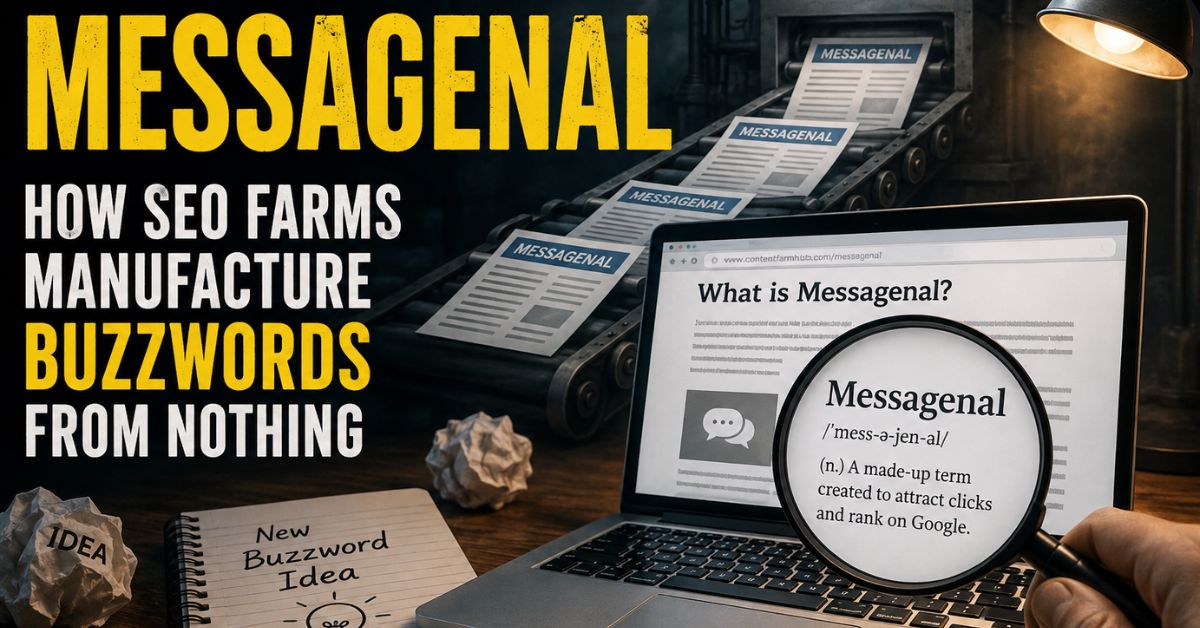
Search for “Messagenal” and you may find pages confidently explaining what it means, where it came from, how businesses use it, and why it supposedly matters.
There is one problem: the word appears to have no established meaning at all.
That does not make Messagenal useless as a case study. Quite the opposite. It shows how low-quality SEO publishing can take an obscure, misspelled, invented, or machine-generated term and turn it into something that looks legitimate simply by repeating it often enough.
A few articles appear. Other sites copy the idea. Search engines index them. Soon, the keyword has its own little ecosystem.
Not because people genuinely use the word.
Because publishers discovered that nobody else was competing for it.
What Is Messagenal?
There is no widely accepted definition of Messagenal.
It is not a standard English word, an established technical term, or a recognized concept with a clear history. Depending on the page you land on, however, you might see it described as a communication system, a digital messaging idea, a branding concept, an online platform, or something related to customer engagement.
Those definitions often contradict one another.
That inconsistency is the giveaway.
When a real term develops inside a profession or community, its meaning usually becomes more precise over time. Writers may disagree around the edges, but they are generally talking about the same thing.
With fabricated SEO keywords, the process runs backward. Writers encounter the unexplained word first and invent an explanation afterward.
Messagenal fits that pattern unusually well.
Why Would Anyone Write About a Word Nobody Uses?
Because search competition matters.
Imagine an established keyword such as “email marketing software.” Thousands of businesses, publishers, review websites, and SaaS companies already compete for it. Ranking near the top can require years of authority, backlinks, useful content, technical SEO work, and a serious budget.
Now imagine a strange keyword such as “Messagenal.”
Perhaps only a handful of pages mention it.
Suddenly, ranking looks easy.
A publisher can produce a 1,500-word article, add headings such as What Is Messagenal?, Benefits of Messagenal, and How Messagenal Works, then wait for Google to index it.
There may be almost no actual audience behind the query. But from the perspective of an automated content farm, the keyword looks attractive because the competition score is close to zero.
Easy rankings can be mistaken for useful rankings.
They are not the same thing.
The Fake-Keyword SEO Cycle
The process usually begins with something mundane.
A typo appears in search data. An AI system invents a word. A domain name resembles an unfamiliar phrase. Someone publishes a badly translated article. Or an automated keyword tool detects a few searches without understanding why those searches occurred.
Then the machinery starts.
One website publishes an explanation.
A second publisher sees that the keyword has little competition and writes another article, often using the first page as indirect inspiration.
Then five more appear.
At that stage, anyone researching the term finds several search results discussing it. The presence of those results creates the impression that the concept must exist somewhere.
Circular evidence.
Site A implies Messagenal is real because Site B discusses it. Site B appears trustworthy because Site C uses the same term. Site C may have generated its article after seeing Site A rank.
Nobody ever establishes the original source.
AI Made This Much Easier
Before large-scale generative writing tools became common, producing hundreds of speculative articles still required considerable labor.
Now the economics are different.
A publisher can feed a keyword into an automated system and request:
Explain Messagenal, its history, benefits, features, uses, and future impact.
If the system lacks reliable information but is instructed to produce an article anyway, it may fill the gaps with plausible-sounding material.
That is where invented certainty becomes dangerous.
A sentence such as “Messagenal is an emerging communication framework designed to improve digital interaction” sounds reasonable. It has the grammar of an explanation. It even resembles the opening sentence of a technology article.
But sounding reasonable is not evidence.
Once published, that invented sentence becomes searchable text. Another AI system can later encounter material derived from it and treat the repetition as support.
The fiction starts feeding itself.
Search Results Can Create an Illusion of Legitimacy
People naturally assume that multiple search results indicate independent confirmation.
Usually, that is a sensible shortcut.
If twenty established medical organizations describe the same condition, for example, the repetition carries real evidentiary weight because those organizations draw on research, clinical standards, and identifiable sources.
SEO farms are different.
Twenty pages may ultimately trace back to one unsupported claim.
Sometimes they do not even trace back that far. They simply produce similar explanations because each writer or language model is trying to infer what the strange keyword ought to mean.
Search engines can index those pages without certifying that the underlying concept is legitimate.
Indexing means a page exists.
It does not mean the page is correct.
That distinction gets lost surprisingly often.
Common Signs of a Manufactured Buzzword
Fake or artificially inflated keywords tend to leave fingerprints.
The first is definition instability. One website calls the term a software platform. Another calls it a philosophy. A third describes it as a marketing technique.
Then there is the missing origin story.
Real concepts usually lead somewhere: a paper, company, inventor, book, standards organization, product launch, patent, dictionary entry, conference, or documented historical use.
Manufactured terms often lead only to more SEO articles.
Dates can be suspicious too. A supposed concept may be described as “rapidly growing” despite almost every result appearing within a few months of one another.
And then there is the language itself.
Articles repeatedly promise to explain the “meaning, benefits, applications, challenges, and future” of something without ever identifying who actually uses it.
That structure can make an empty concept look surprisingly substantial.
Why Messagenal-Type Keywords Keep Appearing
Search publishing rewards discovery.
Finding an overlooked but legitimate topic before competitors can be valuable. Entire websites have grown by answering obscure questions that larger publishers ignored.
The problem is that automated keyword research cannot always distinguish underserved demand from nonexistent demand.
Those are very different opportunities.
An underserved keyword might be a technical error message searched by 2,000 people every month.
A nonexistent keyword might receive a few searches because users encountered the same typo on another spam page.
Both can appear as low-competition queries inside SEO software.
Without editorial judgment, the second one gets treated like the first.
So articles get commissioned.
Zero Competition Is Sometimes a Warning
SEO advice often treats low competition as automatically desirable.
That assumption deserves skepticism.
If nobody has written about a keyword, there may be a brilliant opportunity.
Or there may simply be nothing to write about.
A keyword with ten searches per month and zero credible sources should raise more questions than excitement.
Where did the searches originate?
Are users looking for a company?
Is it a misspelling?
Does Google autocorrect it?
Are people encountering the word on another website?
Is the search volume estimated rather than directly measured?
Those questions matter because SEO tools frequently present precise-looking numbers for very messy human behavior.
A keyword difficulty score of 3 does not prove a market exists.
Fake Keywords Can Pollute Search Engines
The damage is small when one obscure term gets a few nonsense articles.
At scale, however, the effect becomes more serious.
Search engines end up storing millions of pages designed primarily to occupy query space rather than provide verified information. Users searching unfamiliar terms face pages that confidently explain concepts nobody can trace to a credible source.
That makes basic research harder.
It also creates headaches for later publishers. A writer investigating Messagenal might find eight articles and reasonably assume there must be some foundation underneath them.
Then the writer repeats the claims.
This is how information pollution accumulates: not through one spectacular lie, but through thousands of tiny unsupported statements copied with increasing confidence.
The Strange Economics of SEO Content Farms
Why produce an article nobody asked for?
Because content farms do not necessarily evaluate pages individually.
Suppose a publisher creates 20,000 low-cost articles.
Most attract almost no visitors.
A few hundred begin ranking.
A few dozen unexpectedly capture valuable traffic.
Those winners can subsidize the enormous pile of failures.
Under that model, researching whether every keyword represents a real concept may actually cost more than simply publishing an article about all of them.
Messagenal becomes a lottery ticket.
Cheap to produce. Cheap to abandon.
The reader absorbs the cost instead, usually in wasted time.
Expired Domains and Automated Sites Make the Problem Worse
Another source of strange keywords is domain churn.
Websites disappear. Domains expire. New owners buy them because they retain backlinks or search authority. The new site may have nothing to do with the original one.
Automated publishers then fill the domain with whatever queries appear easiest to rank for.
This creates bizarre combinations: celebrity biographies beside software tutorials, gardening articles beside cryptocurrency explainers, followed by a 2,000-word guide to a word nobody has heard before.
Editorial coherence is irrelevant.
Traffic is the product.
That is often why manufactured-keyword pages feel strangely generic. They were never written for a defined readership in the first place.
How to Check Whether a Term Is Actually Real
Do not start by counting search results.
Start by looking for independent evidence.
Search for the earliest documented use of the term. Check dictionaries when appropriate. Look at books, academic databases, patents, official company pages, product documentation, reputable news archives, technical forums, and archived websites.
Context matters more than volume.
If a supposed cybersecurity technique appears only on general-interest blogs but nowhere in security documentation, research papers, or practitioner discussions, something is wrong.
The same logic applies to Messagenal.
A dozen articles defining the word do not establish legitimacy if none can explain where the term originated.
SEO Writers Should Be Comfortable Saying “We Couldn’t Verify It”
This is where editorial standards matter.
A writer does not need to manufacture certainty simply because a keyword exists.
Sometimes the most useful article is the one that says:
We found the search term, investigated it, and could not confirm that it refers to an established concept.
That answer may be less glamorous than inventing six benefits and a future-trends section.
It is also much more useful.
Search content does not have to pretend every query contains a fully formed topic.
Sometimes users are searching precisely because they are confused.
Could Messagenal Eventually Become a Real Word?
Possibly.
Language is messy.
Words can begin as jokes, brand names, typos, slang, usernames, technical shorthand, or deliberate inventions. If enough people adopt a term with a reasonably consistent meaning, it can become legitimate through use.
That is not unusual.
But adoption comes first.
SEO articles predicting what an undefined word could mean do not amount to genuine adoption.
If a software company launched a product named Messagenal tomorrow, for instance, the search term would acquire a concrete referent. Older speculative articles might then look oddly prophetic even though they had nothing to do with the product.
That coincidence would not validate the original claims.
Search Engines Have a Difficult Problem Here
Distinguishing legitimate emerging vocabulary from manufactured nonsense is harder than it sounds.
Every real new term initially has limited evidence.
New products have few mentions. Scientific concepts may begin inside one research group. Internet slang can spread across tiny communities before entering mainstream dictionaries.
A search engine that automatically suppresses every unfamiliar term would bury genuine new information.
But a search engine that accepts repetition as evidence can be manipulated by bulk publishing.
That tension gives SEO farms room to operate.
The web has always contained junk. Generative publishing simply lowered the cost of producing convincing-looking junk at industrial scale.
Messagenal Is More Interesting as Evidence Than as a Definition
Trying to force a neat meaning onto Messagenal misses the useful part of the story.
The keyword exposes how modern search publishing can manufacture apparent importance.
A term does not need a history.
It does not need a user community.
It may not even need a coherent definition.
Give it a handful of indexed pages, repeated headings, confident descriptions, and enough internal links, and it can start looking like a topic people ought to know about.
That is the trick.
The strange little word in the search box is not necessarily the story. The machinery that put it there is.



Most students don’t lose time on an essay because they write slowly. They lose it in the research. You sit down for what should be an hour, and somehow it’s dinner, there are twelve tabs open, three PDFs you’ve only half read, and you still couldn’t explain your topic to a friend. Efficient research isn’t really about speed. It’s mostly about doing a few boring things in a sensible order before you let yourself fall down a rabbit hole.
Research is the core part of writing your essay, as that’s what makes and breaks your entire paper. This is why in this blog, you will learn how to research for an essay efficiently.
Read the Question Twice Before You Search Anything
I know it sounds obvious, but a lot of wasted reading starts here. Before you open Google, go back to the essay question and underline the instruction words.
- Discuss
- Evaluate
- Compare
They all ask for something different, and that changes what you need to find. If you’re asked to evaluate something, a pile of background facts won’t get you far. You need arguments, evidence, and at least one person who disagrees.
Then jot down two or three little questions in your own words, the sort of thing you’d need to know to answer the main one. Those become your search terms, and they keep you from drifting into topics that are interesting but have nothing to do with the essay.
Decide How Much Is Enough
A 1,500-word essay doesn’t need forty sources, and honestly, a lot of students read far more than they ever use. A good rule of thumb is a handful of strong sources for every thousand words, though your thesis or dissertation guide might give an actual number, so check. Once you’ve got a dozen decent ones, more reading mostly just delays the writing.
It helps to give yourself a time limit too. Two hours for the first round of reading, say, and then you move on. That might sound strict, but without a limit the reading tends to swallow the whole week.
Start With the Places That Save You Time
The go-to reliable options are the university libraries and their online archives, where already verified information is available. Several institutions also offer you access to Google Scholar, where you are able to read full text. If you are feeling confused or lost, you can ask your professor or supervisor to create a reading list for you. This can help pointing you to the right direction.
You can look into random websites or blogs easily available for understanding the topic, but they’re hardly reliable as sources for your research papers. What you can do is actually try to get to the source of the information used in the blogs, if the author has mentioned them in credits or cited them.
Read for What You Need, Not Everything
Students think that they need to read each and every line there is on these articles. Perhaps this pressure and load of work is what gets them procrastinating to even begin. Simpler and smarter way is to begin with the abstract, look over the introduction and the conclusion, and only go ahead to reading the entire document if it seems relevant to your research topic. If you’re after one particular point, skim the headings or use the search function in the PDF to jump right to it.
While you read, keep asking whether this actually helps answer your question. If it doesn’t, close it. That one habit probably saves more time than any other strategy.
Write Notes You Can Actually Use Later
Writing notes seems useful and strategic until a student is barely writing any lines or copying entire paragraphs from the article. They may not have the intention, but then their own paper later gets marked for plagiarism. What students can do is find an effective way of taking these notes. They can number the points they extract or organize them in sections for better use later.
When you finally sit down to write, the notes are already sorted, and the essay half builds itself. It also makes accidental plagiarism much less likely, because you’re not lifting phrasing you saved at 2 am.
Save Your Citations as You Go
Perhaps the most frustrating and time taking part of writing a research paper is when you get to the referencing part. You would be done with the thesis but then have to fill in all the references, and then you’re pulling back every article you researched in the beginning.
A better and more organized way to go about citations is to use Zotero or Mendeley. This software is designed and built for researchers, and they automatically create a reference in your preferred format when you enter the article. It is an extra step, but you will be glad you did when the reference list is due.
When the Deadline Is Too Close
Sometimes the plan just falls apart. You’ve got three essays due in the same week, a shift at work and a tutorial you can’t miss, and around midnight a lot of students end up typing pay to do my essay into a search bar, hoping somebody can make the problem disappear.
Before doing that, try making the job smaller. Cut your research down to the three or four sources that matter most, lean on your reading list, and think about emailing your tutor. Plenty of universities have extension policies, and a short, honest message often works better than people expect. Whatever happens, don’t paste in anything you don’t understand, because that’s usually where the real trouble starts.
Know When to Stop
There’s a point where more reading stops improving the essay. If you keep running into the same authors, the same studies and the same arguments, you’ve covered the ground. That repetition is your sign. Stop researching and start writing, then fill any gaps that show up during drafting with a quick, targeted search.
What Help Is Actually Worth It
There’s a big difference between getting help and handing the whole thing over. Some students wonder ‘should I pay someone to do my assignment?’, and it’s worth asking what you’d really be giving up. The research is where most of the learning happens, and your name is the one on the work, with your university’s integrity rules attached to it.
Help that builds your skills usually pays off better. A library workshop on searching databases, an appointment at the writing center, or a friend who’ll read your plan and tell you what’s missing can all make the next essay easier. And the research habits carry over into exams, dissertations and probably whatever job you end up in.
Conclusion
Efficient research mostly comes down to boundaries. A clear question, a sensible number of sources, a time limit, tidy notes and citations saved as you go. None of it is glamorous, but together it turns a vague, anxious week of reading into a few focused sessions. Do it a couple of times and the next essay feels lighter before you’ve even started.

How to Research for an Essay Efficiently

You Are Come Too Late: The MacLellans, Threave Castle, and a Kilt Built for Throwing

Who Is Heidi Brown? All About Gregg Wallace’s Ex Wife

Who Is Rita Johal? All About Riyad Mahrez’s Former Wife and Her Story

Who Is Caroline Hickman? Story of Caroline Hickman, Steve Coogan’s Ex Wife

Who is Sarah Vincent? All About Vic Reeves’ Ex Wife and Their Children
-
 Celebrity4 months ago
Who Is Rita Johal? All About Riyad Mahrez’s Former Wife and Her Story
-
 Celebrity4 months ago
Who Is Caroline Hickman? Story of Caroline Hickman, Steve Coogan’s Ex Wife
-
 Celebrity4 months ago
Who is Sarah Vincent? All About Vic Reeves’ Ex Wife and Their Children
-
 Celebrity4 months ago
The Life of Giselle Glasman: Actress, Theatre Publicist, and Lennie James’ Wife
-

 Celebrity4 months ago
Story of Merula Salaman and Her Life with Alec Guinness
-

 Celebrity4 months ago
Who Is Annie Milner? Untold Story of Paul McGann’s Former Wife
-

 Celebrity4 months ago
Who is Eleasha Hamed? Boxing Legend Naseem Hamed’s Wife
-

 Celebrity4 months ago
Who Was Carolyn Cox? Biography of Nigel Havers’ Ex Wife